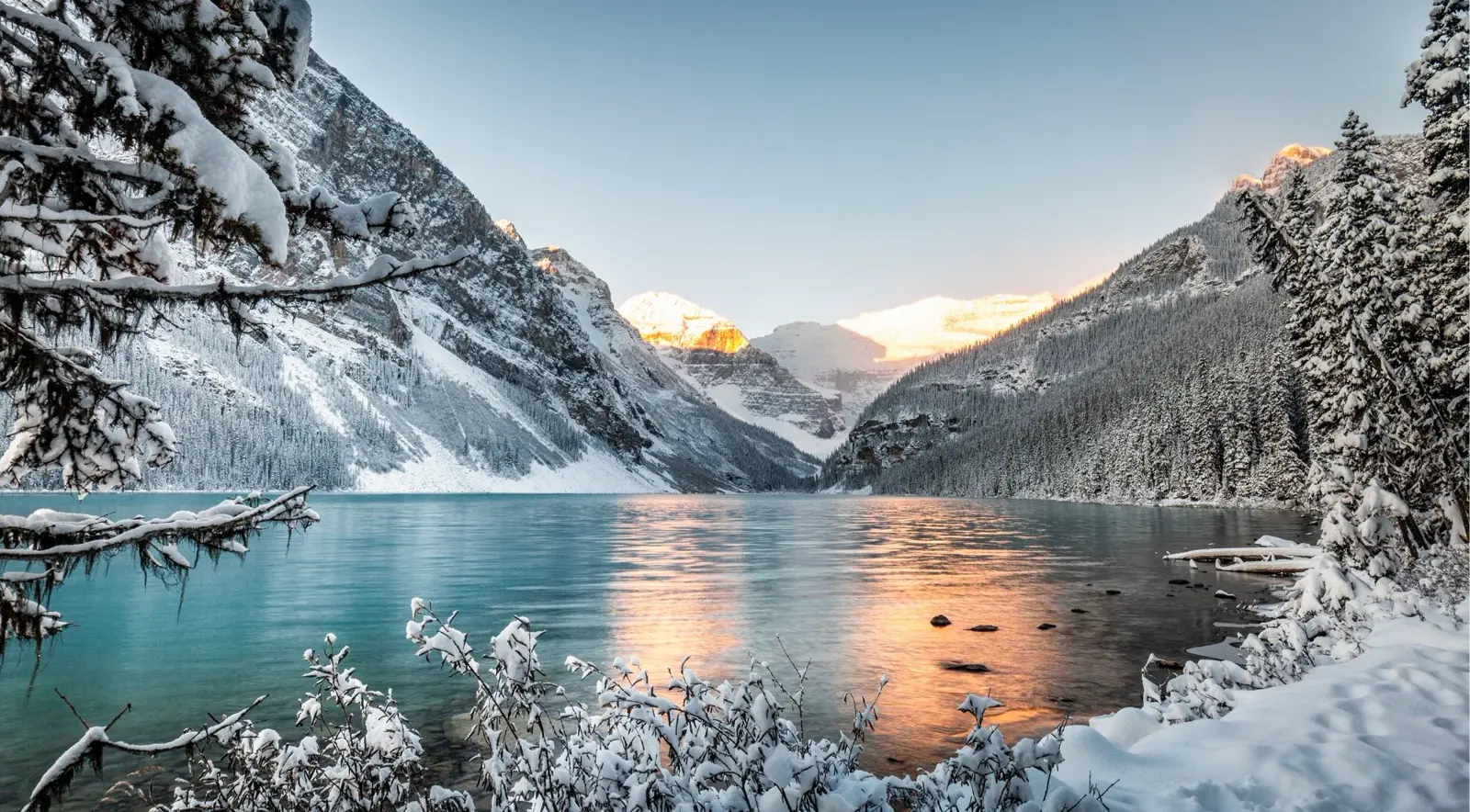
A Whole Park's Worth of Highlights Within an Hour of Banff
Established in 1886, Yoho packs an astonishing density of highlights into just 1,313 square kilometres, and because everything clusters near the Trans-Canada Highway you can see the marquee sights in a single well-planned day.
This is the hub guide to Yoho as a whole destination. For the deep dive on Yoho's most famous lake, see our dedicated Emerald Lake guide; for the fee logistics that apply across all the mountain parks, see our Banff National Park pass guide; and for the Lake O'Hara and Burgess Shale booking mechanics, see our Parks Canada reservation guide.
Emerald Lake, Wapta Falls & Takakkaw Falls Day Trip
This is the rare guided day trip that treats Yoho as the destination rather than as an Emerald Lake photo stop bolted onto a Banff lakes tour. It is the only option on this page that reaches Wapta Falls — and it gives that walk a full two hours, which is what the 4 km round trip actually needs — before finishing at Takakkaw Falls with 45 minutes at the base. Crampons and bottled water are included, and hot drinks in winter.
- Emerald Lake (30 min) and the Natural Bridge (15 min)
- Wapta Falls: guided 4 km round-trip walk, 2 hours on the ground
- Takakkaw Falls (45 min), seasonal — the Yoho Valley Road closes in winter
- Guided in English, Traditional Chinese and Mandarin
Rating and review count are GetYourGuide figures, re-checked live on 8 September 2026. This is a thin review base — 38 ratings — so read the most recent feedback before booking rather than trusting the average alone. Expect a moderate fitness level and wear hiking shoes; meals are not included, and unlike the two lakes tours further down this page the listing does not name the park pass among its inclusions, so budget admission separately outside the free window.
Yoho at a Glance
Yoho National Park was established on October 10, 1886 — originally as the Mount Stephen Reserve — making it, alongside Glacier National Park, one of Canada's oldest national parks after Banff. The name "Yoho" comes from a Cree expression of awe and wonder, which is exactly the reaction the park's towering rock walls and glacier-fed waterfalls tend to provoke. The park spans 1,313 km² and contains 28 peaks over 3,000 metres.
Yoho is part of the Canadian Rocky Mountain Parks UNESCO World Heritage Site, inscribed in 1984 — a designation it shares with Banff, Jasper and Kootenay national parks and three BC provincial parks: Mount Robson, Mount Assiniboine and Hamber. A major reason for that designation is the Burgess Shale, the globally significant Cambrian fossil beds discovered here in 1909. Yoho shares its eastern boundary with Banff, so crossing from Alberta into BC on the Trans-Canada Highway takes you straight into the park.
Worth Adding to Your Yoho Day
If you would rather not drive the Yoho Valley Road switchbacks, compare guided day trips that cover Emerald Lake, the Natural Bridge, Takakkaw Falls and Wapta Falls in Yoho National Park, alongside Lake Louise, Moraine Lake and Johnston Canyon in Banff and Peyto Lake and the Columbia Icefield up the Icefields Parkway, departing from Banff, Canmore, Lake Louise or Calgary.
- 1,313 km²park area
- 373 mTakakkaw Falls total height
- 1886established
- 28peaks over 3,000 m
- ~200residents in Field, BC
How to Get to Yoho from Banff and Calgary
Yoho is bisected by Highway 1, the Trans-Canada, and the small village of Field, BC — home to the park visitor centre — is the natural orientation point. Most visitors arrive by car; there is no in-park public transit to the major sights.
From Banff
Roughly 85 km / about 1 hour to Field via the Trans-Canada Highway.
From Lake Louise
About 27 km / roughly 25–30 minutes to Field. Lake Louise is the closest base to Yoho.
From Calgary
About 210 km / roughly 2.5 hours to Field. Parks Canada lists Calgary's airport as 213 km from the park. See our Calgary to Banff guide for the first leg.
By bus — with a caveat
An EBus Canada scheduled coach runs between Banff and Field, but it does not serve the trailheads — Takakkaw Falls, Emerald Lake and the rest — so a rental car or a guided tour is the practical choice for sightseeing.
Kicking Horse Pass
The highway climbs to the Kicking Horse Pass at the Alberta–BC border, at 1,643 metres the highest point on the entire Trans-Canada Highway. Winter or M+S tires are required October 1 to March 31.
No separate Yoho ticket
You do not buy "Yoho National Park tickets." A single Parks Canada pass covers Banff, Yoho, Kootenay, Jasper and the other mountain parks — see our Banff National Park pass guide. For 2026: under the Canada Strong Pass, admission to all Parks Canada sites is free from June 19 to September 7, 2026, with a 25% rebate on camping fees, according to the Government of Canada. Outside those dates, regular fees apply.
Takakkaw Falls
Takakkaw Falls is the headline attraction and, at a total height of 373 metres (1,224 ft) with a main drop of 254 metres (833 ft), it is the second-tallest waterfall in Canada. It is fed by meltwater from the Daly Glacier in the Waputik Icefield. The name "Takakkaw" is often translated as "it is magnificent"; it was suggested by Canadian Pacific Railway head Sir William Cornelius Van Horne and officially adopted in 1904.
The Yoho Valley Road switchbacks
The falls are reached via the Yoho Valley Road, which branches off the Trans-Canada Highway about 5 km east of Field and climbs roughly 13–15 km into the valley. The road is famous for its tight switchbacks — one hairpin is so sharp that vehicles over 7 metres long must reverse to get around it. Trailers are not permitted and large RVs cannot make the turns; leave them at Monarch or Kicking Horse campground at the base of the road.
Seasonal access only
Because the road crosses avalanche terrain it is closed all winter and opens only seasonally, from mid-to-late June until mid-October, weather permitting. As of early August 2026 the Yoho Valley Road is confirmed open for the season, though Parks Canada has noted that parking is limited.
A 10–15 minute walk
Once the road is open, a large parking area at the end serves as the trailhead. From the lot it is a short, mostly flat walk of roughly 10–15 minutes to the base of the falls. Peak flow is in July, when glacial melt is strongest.
The Spiral Tunnels
The Spiral Tunnels are one of the great feats of railway engineering in North America and a genuinely fascinating — and free — roadside stop. When the Canadian Pacific Railway first pushed through the Kicking Horse Pass in the 1880s, the western descent, nicknamed the "Big Hill," had a punishing 4.5% grade, the steepest mainline railroad in North America. On September 30, 1884, the first construction train attempting to descend the grade derailed and plunged toward the Kicking Horse River, killing three railway workers, and runaway trains and expensive helper engines plagued the line for decades afterward.
The solution, opened on September 1, 1909 and inspired by Swiss mountain railways, was a pair of spiral tunnels bored into the mountains by CPR assistant chief engineer John Edward Schwitzer: the upper tunnel blasted through 991 metres of Cathedral Mountain and the lower tunnel through 891 metres of Mount Ogden. By looping the track back under itself, the tunnels nearly doubled the length of the climb and cut the ruling grade to a manageable 2.2%. Trains long enough can be seen entering a tunnel while the same train's locomotive is already emerging at a different elevation.
Watching trains: there are two viewpoints with interpretive panels. The main Lower Spiral Tunnel viewpoint is on the Trans-Canada Highway a few kilometres east of Field; the Upper Spiral Tunnel viewpoint is 2.3 km up the Yoho Valley Road. The tunnels are still in daily use by CPKC freight trains, so traffic is frequent but unpredictable — there is no published schedule. Plan to linger 15–30 minutes and you have a good chance of catching a train; patience and a little luck are part of the fun.
Wapta Falls
Wapta Falls is the largest waterfall on the Kicking Horse River by volume — sometimes nicknamed the "Niagara of Yoho." It is not tall, at about 18 metres (59 ft), but it is very wide, about 107 metres (351 ft), and the sheer volume of water thundering over the lip is impressive, especially in spring and early summer.
Where Takakkaw is a tall, dramatic plunge you reach in minutes, Wapta is a broad, powerful cascade you earn with a gentle forest walk. The trail is an easy, mostly flat out-and-back of roughly 4.6 km round trip (about 2.3 km each way) with modest elevation gain, taking about 1.5–2 hours. The trailhead is at the far western end of the park, and the access road is unpaved and can be rough; note there is no left turn when heading west, so you continue past and loop back. Because it is tucked away from the main highway corridor, Wapta sees fewer crowds than the marquee sights.
The Burgess Shale
The Burgess Shale is one of the most scientifically important fossil sites on the planet. Discovered by Charles Doolittle Walcott in 1909, these roughly 508-million-year-old Cambrian fossils are extraordinary because they preserve the soft-bodied tissues — eyes, guts, even brains — of ancient marine creatures that would otherwise leave no trace, offering a unique window into the "Cambrian Explosion" of animal life.
Access is highly restricted. The Walcott Quarry and Mount Stephen fossil beds are protected under the Canada National Parks Act and are closed to the public; they may only be visited on a scheduled guided hike led by Parks Canada interpreters, or with a research permit. Independent access is strictly forbidden and can incur heavy fines. The Burgess Shale Geoscience Foundation and Parks Canada operate the guided program.
Walcott Quarry
Rated difficult: about 22–24 km round trip with roughly 800–900 m of elevation gain, an 11-hour day (7 am to 6 pm). It begins near Takakkaw Falls and includes views of Emerald Lake from high above.
Mount Stephen Fossil Beds
Rated difficult: a shorter but very steep hike of about 6–8 km round trip with roughly 780–800 m of gain, taking around 7.5 hours. Renowned for abundant trilobite fossils; starts from near Field.
Booking for 2026
Reservations opened January 20, 2026 at 8 am MT through the Parks Canada Reservation Service (1-877-737-3783). The hikes run in the summer months, roughly July through mid-September, when the trails are snow-free. All participants need a valid national park pass.
Who can go, and how few
Per the Burgess Shale Geoscience Foundation, hikers must be between the ages of 8 and 75, and youth aged 8–18 must be accompanied by an adult. Book far in advance: the Foundation guides a maximum of 12 hikers per group and two groups per day, so no more than 24 people reach the Walcott Quarry daily.
Lake O'Hara
Lake O'Hara is a jewel-blue alpine basin ringed by a world-class network of trails — the Alpine Circuit, Lake Oesa, Opabin Plateau and Lake McArthur among them — widely regarded as some of the finest hiking in the Canadian Rockies. To protect this fragile environment, Parks Canada strictly rations access: the area is reached via an 11 km gated access road, and the shuttle bus into the lake is allocated by lottery.
For 2026, the day-use shuttle lottery ran March 2–23, 2026, and campground reservations opened February 10, 2026. Because the booking mechanics — lottery, cancellation strategies, camping and the Elizabeth Parker Hut — are detailed and change annually, see our Parks Canada reservation guide for the full walkthrough. If you don't win a seat you can still hike the 11 km access road on foot (bikes are not allowed), which adds 22 km round trip to your day.
Emerald Lake
Emerald Lake is Yoho's most famous and most accessible body of water — a stunning turquoise lake ringed by peaks, with the historic Emerald Lake Lodge, the nearby Natural Bridge rock formation and an easy shoreline loop. It is a must-see on any Yoho visit and works beautifully as the first or last stop of a day trip.
Because we cover it in depth elsewhere — parking, the Natural Bridge, the paddling closure, dining and lodge details — we won't duplicate it here. Read our complete Emerald Lake guide for everything you need.
One rule that applies park-wide: all waterbodies in Yoho and Kootenay national parks are closed to private watercraft and angling until March 31, 2027 to limit the spread of whirling disease, with fines of up to $25,000 under the Canada National Parks Act. You cannot bring your own canoe, kayak, paddleboard, inflatable or fishing gear to Emerald Lake or anywhere else in Yoho. The on-site Boathouse Trading Co. rental canoes at Emerald Lake are the one permitted exception, because those boats never leave the lake. Swimming and shoreline use are still allowed. Confirm the current order with Parks Canada before you travel.
Small Group: Emerald Lake (Optional Canoe) & Takakkaw Falls
The opposite trade to the Wapta trip above: fewer stops, far more time at the lake. This one parks you at Emerald Lake for two and a half hours — long enough to walk a good stretch of the shoreline loop, eat, and still queue for a Boathouse canoe — then gives Takakkaw Falls 45 minutes. The national park entrance fee and 5% GST are included, which the Wapta trip does not offer.
Rating and review count are GetYourGuide figures, re-checked live on 8 September 2026 — again a thin base at 37 ratings, so read recent reviews. The canoe is an optional extra you pay for at the lake, not part of the ticket, and gratuities are excluded ($15 cash / $20 by card per person is suggested by the operator).
Where to Stay and Eat in Field
Field, BC — population 195 at the 2011 census, roughly 200 per Parks Canada — sits in the Kicking Horse River valley and is the heart of the park.
The Canadian Pacific Railway built Field in the 1880s to house workers and the helper-engine crews needed to push trains over the Big Hill; the retired CPR water tower still watches over town. Today it is a tight-knit community with limited but characterful services — and no gas station, so fuel up in Lake Louise or Golden.
Truffle Pigs Bistro & Lodge
A 12-room lodge and an award-winning bistro that is widely considered the best dining in the park. Book dinner ahead.
Cathedral Mountain Lodge
A luxury collection of handcrafted log cabins on the Kicking Horse River just off the Yoho Valley Road, about 5 km east of Field.
Emerald Lake Lodge
The upscale historic lodge on the shore of Emerald Lake — see the Emerald Lake guide for rooms, dining and day-visitor access.
Kicking Horse Campground
The main frontcountry campground: 88 sites, flush toilets, showers and firewood, open roughly mid-May to early October, at the base of the Yoho Valley Road. It accepts reservations and holds some first-come sites. There is also a walk-in campground near Takakkaw Falls.
Everything else in town
Field also has the Siding Café for basic conveniences and a couple of local shops — Velvet Antler Pottery and the Friends of Yoho gift shop.
Connectivity
Cell coverage is limited and there is no WiFi in the park. Download maps and booking confirmations before you leave Lake Louise.
Sample One-Day Yoho Itinerary from Banff
Yoho's highlights cluster tightly, so a satisfying loop is very doable in a day from Banff — and even easier from Lake Louise. Here is a realistic plan for a summer day when the Yoho Valley Road is open.
8:00 am — Depart Banff
About an hour's drive west to Yoho.
9:00 am — Lower Spiral Tunnels viewpoint
15–20 minutes. Longer if a freight train is on its way.
9:30 am — Natural Bridge
20–25 minutes, then continue up Emerald Lake Road.
10:15 am — Emerald Lake
Shoreline stroll and photos, 1–1.5 hours.
12:00 pm — Lunch in Field
Truffle Pigs, or a picnic.
1:30 pm — Takakkaw Falls
Drive up the Yoho Valley Road and walk to the base: 1–1.5 hours including the switchback drive.
3:30 pm — Optional: Wapta Falls
Add roughly 2 hours if you have the energy and the daylight — otherwise head back.
5:00–6:00 pm — Return to Banff
Back across the Continental Divide.
If you'd rather not drive the switchbacks or manage the logistics, the guided day trips on this page bundle Emerald Lake, the Natural Bridge and Takakkaw Falls into a single day — one of them adds Wapta Falls. Note that neither includes the Spiral Tunnels viewpoints, which remain a self-drive stop.
Best Time to Visit
July and August — peak
All roads open, maximum waterfall flow, and the Burgess Shale hikes running — but also the biggest crowds and the tightest parking.
Mid-to-late June — the sweet spot
Waterfalls at full roar with slightly thinner crowds. Confirm the Yoho Valley Road has opened before you commit.
September to early October
Cooler weather, golden larches at higher elevations and fewer people — an excellent time to visit, though the Yoho Valley Road closes around mid-October.
Winter
The park is open and beautiful, but Takakkaw Falls and Lake O'Hara are inaccessible by vehicle; activities shift to skiing and snowshoeing. Our practical Banff notes cover regional seasonal detail.
Tips for Visiting
Arrive early
Parking at Takakkaw Falls and Emerald Lake fills fast on summer days.
Fill up first
There is no gas station in Field. Fill up in Lake Louise or Golden.
Leave the trailer behind
RVs and trailers cannot navigate the Yoho Valley Road switchbacks. Drop them at Monarch or Kicking Horse campground.
No paddling or fishing
All Yoho waterbodies are closed to private watercraft and angling through March 31, 2027 because of whirling disease. Swimming and shoreline use are still allowed, and the Boathouse rental canoes at Emerald Lake are the one permitted exception.
Carry bear spray and make noise
Yoho is home to black and grizzly bears, moose, elk and cougars. Keep 100 m from bears and 30 m from other large wildlife, and never feed animals — fines run up to $25,000.
Drive for wildlife
Watch for elk and bears along the Kicking Horse River and the highway, and obey reduced speed limits and no-stopping zones. A beloved white grizzly known as Nakoda (Bear 178) was killed in a Trans-Canada Highway collision near the Lake O'Hara turnoff in June 2024, with her two cubs killed in a separate collision the same week — a sobering reminder to slow down.
Check before you go
Confirm road openings, trail closures and any wildfire activity with Parks Canada before you leave. A park-wide fire ban took effect July 30, 2026.
Yoho National Park FAQ
Where is Yoho National Park?
Yoho is in southeastern British Columbia, on the western slope of the Rocky Mountains, directly adjacent to Banff National Park across the Continental Divide. Its main hub is the village of Field, on the Trans-Canada Highway.
How far is Yoho National Park from Banff?
Field is about 85 km (roughly 1 hour) west of the town of Banff via the Trans-Canada Highway. From Lake Louise it is only about 27 km (25–30 minutes), and from Calgary about 210 km (roughly 2.5 hours).
Do I need tickets or a pass for Yoho National Park?
There are no separate Yoho tickets. A single Parks Canada pass covers Yoho and the other mountain parks. In 2026, admission is free June 19 – September 7 under the Canada Strong Pass. See our Banff National Park pass guide.
When does the road to Takakkaw Falls open in 2026?
The Yoho Valley Road to Takakkaw Falls opens seasonally, typically mid-to-late June, and closes around mid-October. As of early August 2026 it is confirmed open for the season, with limited parking. Always check Parks Canada's road status before you go.
Can you visit the Burgess Shale on your own?
No. The Walcott Quarry and Mount Stephen fossil beds are legally protected under the Canada National Parks Act and can only be visited on a Parks Canada guided hike, or with a research permit. Independent access can incur heavy fines. Reservations for 2026 opened January 20, 2026.
How do you get to Lake O'Hara?
Access is by a lottery-allocated shuttle bus, by staying at the campground, hut or lodge, or by hiking the 11 km access road on foot, which adds 22 km round trip to your day. Bikes are not allowed. The 2026 day-use lottery ran March 2–23. See our Parks Canada reservation guide.
Can I canoe on Emerald Lake in 2026?
Not with your own boat. All waterbodies in Yoho and Kootenay national parks are closed to private watercraft and angling until March 31, 2027 because of whirling disease. The on-site Boathouse Trading Co. rental canoes at Emerald Lake are permitted because they never leave the lake. Swimming and shoreline activities are still allowed.
Can you see Yoho in one day from Banff?
Yes. The main sights — Emerald Lake, the Natural Bridge, the Spiral Tunnels and Takakkaw Falls — cluster near the highway and can be comfortably seen in a full day. Wapta Falls or the Burgess Shale hikes each require additional time.