- No carsprivate vehicles banned all year
- Jun 1–Oct 122026 road & shuttle season
- $12.75Parks Canada shuttle, return
- 1,884 melevation, Valley of the Ten Peaks
- Apr 152026 shuttle bookings open
Moraine Lake in 2026: What You Need to Know Before You Go
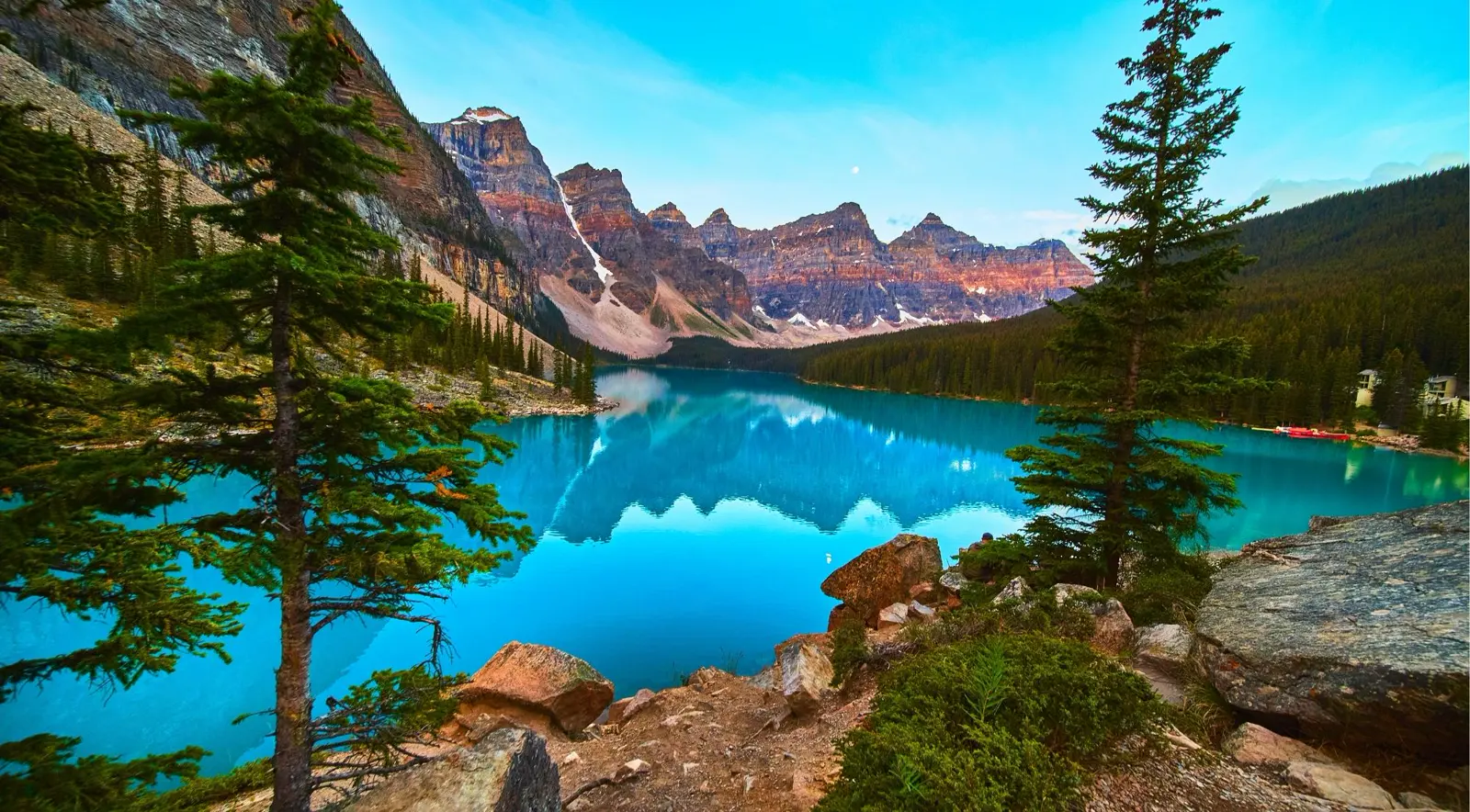
Moraine Lake is one of the most photographed places in Canada — the deep-turquoise lake set below the Valley of the Ten Peaks, at 1,884 m in Banff National Park. The view from the Rockpile, the spot that appeared on the back of Canada's $20 bill from 1969 to 1979, is as spectacular as the photographs suggest. But reaching it takes a little planning, because Moraine Lake Road has been closed to private vehicles year-round since 2023, and demand for the Parks Canada shuttle has grown dramatically every year since. This guide covers everything; for specific angles, see how to get to Moraine Lake without a car, the Lake Louise & Moraine Lake shuttle guide, how the Parks Canada reservation system works, and Moraine Lake vs Lake Louise if you're deciding between the two.
For 2026, the road is open June 1 to October 12 — no exceptions for accessibility placards. There is one major new change: a Parks Canada watercraft ban, effective spring 2026, prohibits bringing personal canoes, kayaks or paddleboards onto the lake to prevent the spread of whirling disease. On-site canoe rental from Moraine Lake Lodge is still available. Everything else — the Rockpile, the lakeshore walk, the hiking trails, the Valley of the Ten Peaks — is as striking as ever.
2026 key facts
- Private vehicles banned year-round, including accessibility placards
- Road open June 1 – October 12, 2026 (weather permitting)
- New: personal watercraft ban — rental canoes from Moraine Lake Lodge only
- Parks Canada shuttle bookings open April 15, 2026 at 8 a.m. MDT
- Canada Strong Pass gives free park entry June 19 – September 7, 2026
What to do at the lake
- Rockpile Trail — the classic "Twenty Dollar View" (30 min, easy)
- Lakeshore Trail — flat walk along the turquoise water (45 min)
- Canoe rental from Moraine Lake Lodge dock (from CAD $160/hour)
- Larch Valley and Eiffel Lake hiking trails
- Consolation Lakes — the best family-friendly longer walk
The Easiest Way to Reach Moraine Lake: A Guided Tour
No Parks Canada reservation to win, no drive to the Park & Ride — hotel pickup from Banff, Canmore or Calgary, with the park pass and Moraine access included.
Emerald Lake, Moraine, Louise, Johnston Canyon & Banff Town
Why this works for Moraine Lake: the road is closed to private cars, which means every independent visitor still needs to win a Parks Canada shuttle reservation or book a commercial operator. This tour bundles the park pass and Moraine access into one price, picks you up in Banff, Canmore or Calgary and adds Lake Louise, Emerald Lake and Johnston Canyon in the same day.
A local guide, who reviewers consistently describe as the group's photographer, sequences the stops to stay ahead of the mid-day crowds. The tour holds a 4.8 rating across 2,000+ verified reviews.
- Hotel pickup and drop-off in Banff, Canmore or Calgary
- Reaches Moraine Lake — no Parks Canada reservation needed
- National park pass included
- Lake Louise, Emerald Lake and Johnston Canyon in the same day
- Local guide, drinking water and photo stops
Pickup in Banff, Canmore and downtown Calgary. Check live dates and book below.
Worth Adding to Your Banff Itinerary
Most visitors to Moraine Lake pair it with Lake Louise — the two are connected by the free Parks Canada Lake Connector shuttle and are only 15 minutes apart. Popular additions from there include Emerald Lake and the Natural Bridge in Yoho National Park, the Johnston Canyon waterfall walk, the Columbia Icefield and Icefields Parkway, and the Banff Gondola up Sulphur Mountain. If you're driving from Calgary, the full Icefields Parkway day trip is a natural extension. Browse current availability below.
How to Get to Moraine Lake in 2026 — All 4 Access Options
The Parks Canada shuttle, a commercial operator, the Roam Super Pass, or a guided tour — what each costs and who each suits.
The closure wasn't arbitrary. Parks Canada told CBC News that "since 2018, Parks Canada has had to actively manage an increasing amount of traffic along Moraine Lake Road. While in previous years, traffic management occurred between sunrise and sunset, in 2022, flaggers were required 24 hours a day." At peak times in summer 2022, about 900 vehicles a day gained access while roughly 5,000 were turned away. The road also runs through core grizzly habitat and two wildlife corridors, so the closure serves congestion, safety and conservation together.
Parks Canada Park & Ride shuttle
Board at the Lake Louise Park & Ride, 1 Whitehorn Road. Return fare: adult CAD $12.75, senior $6.00, youth (17 and under) $4.00, plus a one-off $3.50 online reservation fee. One ticket covers both lakes via the free Lake Connector. Reservations open April 15, 2026 at 8 a.m. MDT (40% of seats) then roll out at 8 a.m. MDT two days before each departure. Parking at the lot is free with a reservation.
Commercial shuttle operators
Moraine Lake Bus Company, Fairview Limousine, Via Via and others offer reserved seats when Parks Canada is sold out, with sunrise departures (4–5 a.m.) that Parks Canada's Park & Ride shuttle doesn't run. Fares range roughly CAD $35–115+ per person return depending on time and operator. Best for sunrise seekers or anyone who can't secure a Parks Canada reservation. Full shuttle comparison →
Roam Transit Reservable Super Pass
The only Roam product that reaches Moraine Lake (Route 10 does not operate in 2026). The Reservable Super Pass (~CAD $30) covers unlimited Roam routes plus a round-trip on the Parks Canada Lake Connector to Moraine Lake. You must start your journey at the Banff High School Transit Hub — if you're starting from Lake Louise, this option does not apply. You must board the Lake Connector to Moraine by 4:30 p.m.; last return from Moraine to Lake Louise is 6 p.m. Reservation windows open online only at 9 a.m. MT: June travel opened April 23 · July opened May 25 · August opened June 22 · September–October 12 opened July 27. A non-refundable $3 booking fee applies. Sells out fast for July and August.
Guided tour with hotel pickup
A full-day guided tour picks you up in Banff, Canmore or Calgary, includes the park pass and Moraine access, and usually pairs the lake with Lake Louise, Emerald Lake and Johnston Canyon. There is no Parks Canada reservation to win and no drive to the Park & Ride. Best for first-time visitors who want zero logistics and several lakes in a single day.
What to Expect at Moraine Lake — and the Valley of the Ten Peaks
Moraine Lake sits at 1,884 m in a rugged glacial valley, and Parks Canada classifies it as a backcountry location: there is no cell service, no Wi-Fi, no running water and no lighting at the lake. Pit toilets are available, and a small café and gift shop operate at Moraine Lake Lodge. Cell reception returns roughly 5 km back down the road toward the highway. Dress in warm layers even in July — pre-dawn temperatures are near freezing — and screenshot or print your shuttle reservation before you leave connectivity behind.
Why the water is that colour: Moraine Lake is fed largely by the Wenkchemna Glacier. As the glacier grinds against bedrock it produces an ultra-fine sediment called rock flour (glacial silt), which stays suspended in the meltwater. When sunlight hits those particles, the Tyndall effect scatters the shorter blue and blue-green wavelengths back to your eye while the longer reds and yellows are absorbed — producing the signature turquoise. The colour is most intense from late June through early September, when glacial melt (and rock-flour concentration) peaks; earlier in spring, before significant melt, the water reads as a darker, more conventional blue.
Why it's called the Valley of the Ten Peaks: in 1894, explorer Samuel Allen — travelling with Walter Wilcox — named the ten mountains ringing the lake using the numbers of the Stoney Nakoda language, from Heejee (one) through Wenkchemna (ten). Wilcox named the lake itself for the glacial moraines he believed dammed it. Seven of the peaks were later renamed for individuals; only three keep their original Stoney Nakoda names today — Tonsa, Neptuak and Wenkchemna. From east to west the ten are Fay, Little, Bowlen, Tonsa, Perren, Allen, Tuzo, Deltaform, Neptuak and Wenkchemna. This exact panorama appeared on the back of Canada's $20 bill in the 1969–1979 "Scenes of Canada" series, based on a Canadian Pacific Railway photograph — the origin of the "Twenty Dollar View" nickname.
Moraine Lake at Sunrise: The "Twenty Dollar View" at Its Best
Calm water, golden light on the Ten Peaks and the thinnest crowds of the day — sunrise is the moment to be here, and it takes planning to make it happen.
Sunrise is the reason seasoned visitors set their alarms for 4 a.m. The lake at first light is calm enough to mirror the Valley of the Ten Peaks, the golden alpenglow strikes the summits before the coaches arrive, and the Rockpile viewpoint — where 75,000 people queued to see at mid-day just a few years ago — is quiet enough to appreciate. Because tall peaks ring the lake, golden light on the water typically arrives 20–40 minutes after the official sunrise time; plan around first light, not the sunrise app. For shot lists and the other dawn spots worth an alarm, see our Banff photography & sunrise guide.
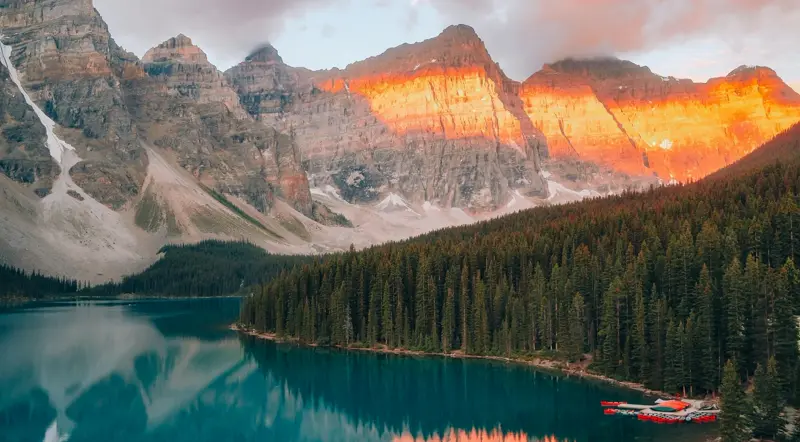
In June, sunrise falls around 5:00–5:30 a.m. (earliest near the June 21 solstice). It shifts later through summer. Given the vehicle ban, sunrise access options are the Parks Canada Alpine Start shuttle, a commercial sunrise operator, or cycling in before dawn — though it's technically allowed rather than recommended (see below).
-
Parks Canada Alpine Start (cheapest sunrise option)
Departs 4 a.m. and 5 a.m. daily (June 1 – October 12) from the Lake Louise Lakeshore parking lot — not the Park & Ride. Paid parking at that lot applies ($42/vehicle). Returns via the Lake Connector. Note: accessible shuttle service is not available on Alpine Start departures in 2026. You still need a Parks Canada shuttle reservation.
-
Commercial sunrise operators (guaranteed seats)
Moraine Lake Bus Company runs sunrise departures as early as 4 a.m. from Samson Mall in Lake Louise. Fairview Limousine, Via Via and Discover Banff Tours offer sunrise trips from Lake Louise, Banff and Canmore — with hotel pickup and guide included on some options. Expect roughly CAD $85–130+ per person. These are the most reliable option if you need a guaranteed sunrise seat without the Parks Canada reservation lottery.
-
Cycling the road pre-dawn
Hiking or biking in is technically allowed but not recommended: it's roughly 14 km one-way from the community of Lake Louise, with about 527 m of elevation gain, no shoulder, and steady commercial-bus traffic once the day shuttles begin. Bring a headlamp, bear spray, and expect to arrive well before the first shuttles (which begin loading from 6:30 a.m. at the Park & Ride). No personal-vehicle parking is allowed at the road's start.
Moraine Lake Sunrise & Lake Louise Golden Hour Experience
A dedicated sunrise experience that pairs the Moraine Lake Rockpile at first light with Lake Louise in golden hour — the shot most visitors spend a whole summer trying to time. Small-group, hotel pickup from Banff and Canmore, with a guide who knows exactly when and where to position you on the Rockpile.
Moraine Lake Hiking Trails 2026: Rockpile to Sentinel Pass
All trails start at the Moraine Lake day-use area. Grizzly bears frequent this valley — always carry bear spray and be ready for Parks Canada's group-of-four requirement on the higher trails.
Rockpile Trail — the Twenty Dollar View
A short switchbacking climb of about 120 stone steps — roughly 300 m one-way — to the most photographed view in Canada: the deep-turquoise lake below the Valley of the Ten Peaks. Suitable for almost anyone able-bodied, but the stairs mean it is not wheelchair accessible; visitors with limited mobility can enjoy lake views from the flat Lakeshore Trail or the benches near the canoe dock instead. Busy by mid-morning; sunrise or late afternoon are the quietest windows. Watch for pikas and chipmunks in the rocks — please don't feed them.
Lakeshore Trail
A flat walk along the turquoise water to views of Mount Fay and the Fay Glacier. Minimal elevation gain. Good for families and anyone who wants to be at water level rather than above it.
Consolation Lakes
The most family-friendly longer option. Crosses a boulder field past the Tower of Babel to quiet alpine lakes below the Quadra Glacier. Parks Canada also runs a guided "Consolation Lakes: Wildlife Conservation" hike on select dates July–September 2026 (adult CAD $95.25).
Larch Valley
Steep forested switchbacks open into a larch-filled meadow beneath the Ten Peaks. Larch Valley alone is a worthwhile turnaround without continuing to Sentinel Pass — about 8.6 km round trip. Spectacular in late September when the larches turn gold — Banff's second-busiest period after summer. Group of four may be required during bear activity (check the trailhead sign).
Sentinel Pass via Larch Valley
Continues past Minnestimma Lakes to one of the highest hikeable passes in Banff (2,611 m), overlooking Paradise Valley. About 11.6 km round trip and 720–790 m of elevation gain. One of the Rockies' signature full-day hikes; time your return shuttle carefully.
Eiffel Lake
Shares the first switchbacks with Larch Valley then traverses high along the valley for up-close Ten Peaks views. Far quieter than Larch Valley. Strong hikers can extend to Wenkchemna Pass on the Continental Divide — about 20 km round trip with roughly 1,000 m of total elevation gain. An excellent alternative for those who want the elevation without the larch-season crowds.
Bear safety: Parks Canada may require hikers to travel in tight groups of four or more on the Larch Valley, Sentinel Pass and Eiffel Lake trails during bear activity — wardens check group size at the trailhead and can turn back or fine smaller groups. Always carry bear spray (rentals are available in Lake Louise and Banff). See full wildlife safety details below.
Canoeing at Moraine Lake in 2026: Rental-Only, No Personal Boats
Paddling the turquoise water below the Ten Peaks is one of Moraine Lake's most memorable experiences — and it's still possible in 2026, but only using on-site rental canoes. Parks Canada's new watercraft ban, effective spring 2026, prohibits bringing personal canoes, kayaks or paddleboards onto Moraine Lake, Bow Lake and Lake Minnewanka, as part of a Water Preservation Zone policy aimed at preventing the spread of whirling disease, which was confirmed in Lake Louise in 2025. Our canoeing in Banff guide compares rental prices and rules across every paddleable lake.
The trigger was whirling disease — which, per the Rocky Mountain Outlook, "can have a 90 per cent mortality rate in some fish species." Parks Canada's Sarah Veillard explained the reasoning: "We tested fish from Moraine Lake in 2025, and all of them came back negative for whirling disease… Preventing the introduction of aquatic invasive species into Moraine Lake will improve our ability to restore Moraine Lake and the watershed in the future for species-at-risk." Swimming, snorkelling and fishing without waders can still continue as normal — it's only personal watercraft that are restricted.
Rental canoes from Moraine Lake Lodge: available on a first-come, first-served basis (no reservations) from the lodge dock, typically mid-June to mid-September. Starting at CAD $160 plus 5% GST per canoe per hour; each canoe holds two to three people. Pets are not permitted in rental canoes, and registered guests of Moraine Lake Lodge receive one complimentary canoe trip. Arrive early — mornings are calmest and lines build by mid-afternoon. The dock closes without notice in high wind or rain, and hours vary by month (roughly 9 a.m.–5:30 p.m., last rental around 4 p.m., but confirm on arrival as these are not officially published).
Getting to Moraine Lake from Banff, Calgary and Lake Louise
All Parks Canada shuttles depart from the Lake Louise Park & Ride at 1 Whitehorn Road. Here's how to reach it — and how long it takes from the most common starting points.
From Lake Louise Village
The Park & Ride is at the Lake Louise Ski Resort, approximately 2.6 km from the Trans-Canada Highway exit — a few minutes by car. Lake Louise Village is the easiest base for Moraine Lake day access; parking at the lot is free for reservation holders. The shuttle ride from the Park & Ride to Moraine Lake takes roughly 20–30 minutes.
From the Town of Banff
Approximately 57–61 km and 45–50 minutes' drive via the Trans-Canada Highway (Hwy 1) to the Lake Louise exit. The scenic Bow Valley Parkway (Hwy 1A) takes about 1 hour 10 minutes. Car-free: take Roam Route 8X (Lake Louise Express) from the Banff High School Transit Hub, then use the Roam Reservable Super Pass to connect to the Lake Connector to Moraine Lake.
From Canmore
Canmore is approximately 25 km east of Banff. Car-free visitors can take Roam Route 3 from Canmore into Banff, then connect to Roam Route 8X and the Reservable Super Pass combination. Driving from Canmore to the Lake Louise Park & Ride takes about 1 hour via the Trans-Canada Highway.
From Calgary / YYC Airport
Approximately 184–200 km and about 2 hours' drive west on Highway 1. There is no direct public transit from Calgary to Moraine Lake. Your options are driving to the Park & Ride and taking the Parks Canada shuttle, or booking a guided tour that picks up in Calgary and handles Moraine Lake access directly — no Parks Canada reservation required.
Best Time to Visit Moraine Lake in 2026
Season
Moraine Lake Road and its shuttle run June 1 – October 12, 2026. The road is gated in winter due to snow and avalanche danger. The lake is inaccessible off-season — if you visit Banff in winter, substitute a Lake Louise snowshoe or ice-walk.
Peak turquoise colour
The lake doesn't fill with meltwater until mid-to-late June. Vivid blue-green colour peaks in mid-July as glacial melt maxes out. In early June the lake may still be partly ice-covered — beautiful, but not the postcard turquoise.
Larch season
Late September — roughly the last two weeks — brings a second surge as hikers come for the golden larches in Larch Valley. The scenery is spectacular but shuttles sell out fast; book transport weeks ahead.
Quieter times
Early June and late September have thinner crowds and excellent light. Within any day, sunrise and late afternoon (after 4 p.m., when day-tour groups leave) are calmest. Evening shuttles are limited, so late visitors often have the lake nearly to themselves.
Peak crowds
July and August are busiest. The Rockpile fills early and commercial-operator Parks Canada fees (introduced 2025) mean guided tours are priced higher in peak season. The Canada Strong Pass gives free park entry June 19 – September 7, 2026.
Wildfire smoke
August carries the highest risk of wildfire smoke from BC and Alberta fires, which can significantly reduce visibility and air quality at the lake. Late June and early October are the clearest months statistically.
Wildlife Safety at Moraine Lake
The entire Moraine Lake area is core grizzly bear habitat. On the longer trails — Larch Valley/Sentinel Pass, Eiffel Lake and Consolation Lakes — Parks Canada seasonally imposes a mandatory "tight group of four" restriction, typically from mid-July through mid-October, which covers all of larch season. When it's in effect, you must hike in a group of at least four people, staying within a few metres of one another; wardens check group size at the trailhead, turn back smaller groups, and can fine violators. If you're a solo hiker or a couple, it's easy and common to team up with other visitors at the trailhead during larch season — most people are happy to join forces to meet the requirement. Always carry bear spray where you can reach it quickly (rentals are available in Lake Louise and Banff if you don't want to buy a canister), make noise on the trail, and check the Parks Canada trail report or the trailhead bulletin board for the day's status before setting out. The short Rockpile and Lakeshore trails are exempt from the group requirement.
Tips for Visiting Moraine Lake
- Book the instant reservations open — April 15, 2026, 8 a.m. MDT — or set an alarm for the 8 a.m. MDT release two days before your date.
- Arrive at the Park & Ride early and check in at the kiosk during your booking window; expect to wait 30–60 minutes for a bus at peak times.
- Dress for near-freezing dawns even in summer, and bring water, snacks and layers — there are no services at the lake itself beyond pit toilets and the lodge café.
- Screenshot your reservation before you lose cell service — coverage disappears about 5 km before the lake.
- Plan a half or full day: a half-day covers the Rockpile and lakeshore; a full day lets you add Larch Valley, Eiffel Lake or Consolation Lakes.
- Choose your first destination carefully when booking — the shuttle takes you to that lake first, and you switch to the other via the free Lake Connector.
Moraine Lake 2026: Frequently Asked Questions
Access, watercraft rules, hiking, sunrise timing and when to visit — answered.
Can you drive to Moraine Lake in 2026?
No. Moraine Lake Road has been closed to all private vehicles year-round since 2023, and the policy continues for 2026. There is no public parking at the lake. The only ways in between June 1 and October 12, 2026 are the Parks Canada Park & Ride shuttle, a licensed commercial shuttle, the Roam Transit Reservable Super Pass with the Lake Connector, or a guided tour. See our guide to visiting Moraine Lake without a car for a full comparison of every option.
How do I get to Moraine Lake without a car?
Reserve a Parks Canada shuttle from the Lake Louise Park & Ride, book a licensed commercial or sunrise tour operator, or use a Roam Transit Reservable Super Pass from Banff — Route 8X from the Banff High School Transit Hub to Lake Louise Lakeshore, then the free Parks Canada Lake Connector. Roam only works if you start your journey in Banff; there is no Roam route to Moraine Lake from Lake Louise itself.
When do Moraine Lake shuttle reservations open for 2026?
Bookings open on the Parks Canada Reservation Service on Wednesday, April 15, 2026 at 8:00 a.m. MDT, when 40% of the season's seats are released. The remaining 60% are released on a rolling basis at 8:00 a.m. MDT exactly two days before each departure date. Set up your reservation account (or a free GCKey login) in advance — launch morning is high-demand and popular dates sell out fast.
How much does the Moraine Lake shuttle cost?
Per the official Parks Canada fees page, fares are $12.75 adult, $6.00 senior (65+) and $4.00 youth (17 and under), plus a non-refundable $3.50 online reservation fee ($5.50 by phone) applied once per booking. A separate national park entry fee is required and is not included in the shuttle ticket, though the Canada Strong Pass gives free park admission from June 19 to September 7, 2026. Parks Canada adjusts fees annually, so confirm current pricing before booking.
When is Moraine Lake open in 2026?
Moraine Lake Road and its shuttle service run from June 1 to October 12, 2026, weather permitting. The road is gated and closed all winter due to snow and avalanche danger. The lake reaches its most vivid turquoise colour from mid-June through July, and larch season peaks in late September.
When is the best time to visit Moraine Lake?
Sunrise is the single best time — alpenglow on the Ten Peaks, dead-calm water for reflections and the thinnest crowds — though in June and July the regular shuttle's earliest departure (6:30 a.m.) can arrive after the sun is up, so book the Alpine Start shuttle or a sunrise tour if that matters to you. July and August bring the most vivid turquoise and warmest weather but the heaviest crowds and the highest wildfire-smoke risk. Larch season, roughly September 20 to early October, pairs golden larch meadows with turquoise water and softer light, though a second wave of crowds arrives once the larches peak.
Why is Moraine Lake so blue?
The intense turquoise colour comes from glacial rock flour — extremely fine rock particles ground by the Wenkchemna Glacier and carried into the lake by meltwater. Sunlight scatters off these suspended particles (the Tyndall effect), reflecting the blue-green end of the spectrum back to your eye. The colour is most vivid from mid-June through September once summer glacial melt fills the lake; in early June it may still be partly ice-covered.
Can you canoe on Moraine Lake in 2026?
You can canoe, but only using on-site rental canoes from Moraine Lake Lodge — you can no longer bring your own boat. In spring 2026, Parks Canada banned personal canoes, kayaks and paddleboards on Moraine Lake (and Bow Lake and Lake Minnewanka) to prevent the spread of whirling disease. Rental canoes are available on a first-come, first-served basis at the Moraine Lake Lodge dock from around mid-June to mid-September, starting at CAD $160 plus tax per hour for a canoe holding two to three people. Swimming and fishing without waders are still allowed, pets aren't permitted in rental canoes, and registered lodge guests get one complimentary canoe trip.
What are the best short hikes at Moraine Lake?
The Rockpile Trail (about 300 m one-way, 0.8 km round trip, 10–20 minutes) climbs about 120 steps to the classic "Twenty Dollar View" over the Valley of the Ten Peaks — the most popular short walk. The Lakeshore Trail (1.3 km one-way, 45 minutes) is a flat stroll along the turquoise water. For something longer, Consolation Lakes (2.9 km one-way, 2 hours) is the most family-friendly option. Larch Valley (4.5 km one-way, moderate — or about 8.6 km round trip as a standalone turnaround) and Eiffel Lake (5.7 km one-way, moderate) are the showcase high-elevation hikes.
Do I need to hike in a group at Moraine Lake?
On the longer trails — Larch Valley, Sentinel Pass, Eiffel Lake and Consolation Lakes — yes, a mandatory "tight group of four" bear restriction is often in effect from mid-July through mid-October, covering all of larch season. Wardens check group size at the trailhead and can turn back smaller groups or issue fines; solo hikers and couples commonly team up with other visitors at the trailhead to meet the requirement. The short Rockpile and Lakeshore trails are exempt.
Is the Rockpile Trail accessible?
No. The Rockpile involves a short climb of about 120 stone steps and is not wheelchair accessible. Visitors with limited mobility can still enjoy lake views from the flat Lakeshore Trail or the benches near the canoe dock.
What is the "Twenty Dollar View" at Moraine Lake?
The "Twenty Dollar View" is the panoramic view of Moraine Lake and the Valley of the Ten Peaks as seen from the Rockpile Trail viewpoint. The scene appeared on the reverse of the Canadian $20 bill in the 1969–1979 Scenes of Canada series, and the nickname stuck. It is reached by a short, steep climb of about 120 stone steps from the Moraine Lake day-use area and is considered one of the most photographed views in Canada.
What time should I arrive at Moraine Lake for sunrise?
Aim to be at the Rockpile at least 30 minutes before the official sunrise time — in June, that means arriving around 4:30–5:00 a.m. Because tall peaks surround the lake, golden light on the water typically arrives 20–40 minutes after official sunrise. Access options for pre-dawn arrival are the Parks Canada Alpine Start shuttle (departs 4 a.m. and 5 a.m. from the Lake Louise Lakeshore lot) and commercial sunrise operators such as Moraine Lake Bus Company, Via Via and Discover Banff Tours.