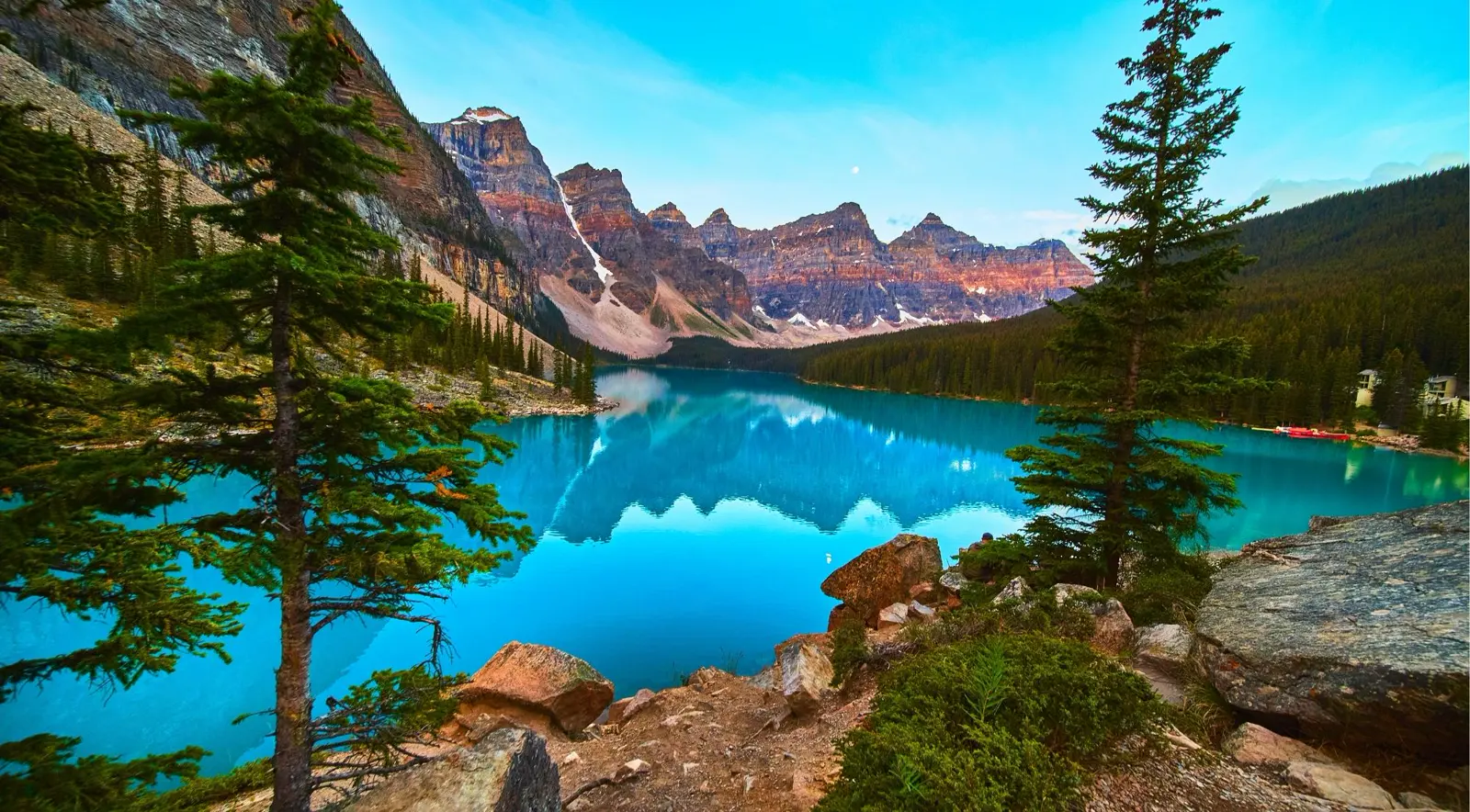
Banff National Park never closes, but several of its best-known experiences do: the Moraine Lake Road, the Lake Minnewanka cruise and most ski-lift terrain all run for only part of the year. Which version of Banff you get depends more on that seasonal access than on the weather alone — lake and trail access needs roughly June through September, and skiing needs roughly November through April.
If your dates are flexible and lakes and hiking are the priority, the second half of September offers the best overall balance: near-summer scenery and often golden larch colour, with thinning crowds and easing prices. July and August have the most reliable warm weather and every trail open, but they are also the busiest and most expensive weeks of the year.
For skiing, aim for January through March, when all three resorts have the most reliable snow. For the lowest prices and fewer crowds, choose April or November, accepting that the lakes stay frozen and the high trails stay snowbound. When Moraine Lake Road is open, arrive before 9am — both lakes fill fastest from mid-morning on.
- Best overall (first visit, lakes & hiking)
- Second half of September
- Best weather & full trail access
- July – August
- Best for the golden larches
- ~Sep 20 – Oct 5
- Best for skiing
- January – March
- Best for fewer crowds & lowest prices
- April or November
- 17°CSept average high
- 45mmSept average precipitation
- 12h 42mSept daylight, mid-month
- Jun 1–Oct 12Moraine Lake Road, typical
Banff Gondola Admission Ticket
If your travel dates fall outside the lake and ski seasons, start here. The Banff Gondola up Sulphur Mountain runs every month of the year, which makes it the one attraction this whole page does not need to gate by date. Operator Pursuit layers seasonal programming on top of the standard ticket throughout the year, from a spring brunch series to a Christmas light show.
- Round-trip ride to the summit, open year-round
- 360-degree rooftop observation deck and the Above Banff Interpretive Centre
- Boardwalk to Sanson's Peak, cleared and walkable in winter
- Free Banff Gondola shuttle or Roam Transit from town
Rating and review count checked live 2026-09-08. This ticket is non-refundable: unusually for the tours on this site there is no free-cancellation window, so settle your dates before you buy. Full ticket and timing detail is in our Banff Gondola guide.
Check Any Date
Pick a date and see what's typically open, what the weather usually does, and which tour actually fits.
Temperature is interpolated between mid-month normals; precipitation is the month's normal total, not a forecast. Environment Canada climate normals for Banff — see How we know.
Dates are typical patterns, not this year's confirmed schedule — see How we know.
Other Experiences You Might Enjoy
Whichever season you land on: the Banff Gondola runs in all twelve months, guided days to Moraine Lake and Lake Louise run June to October, Columbia Icefield glacier tours run along the Icefields Parkway in summer, and evening wildlife safaris run from Banff, Canmore or Calgary.
- 4.5Mvisitors in 2025 (record)
- 22.5°CJuly average high
- −13.5°CJanuary average low
- Jun 1 – Oct 12Moraine Lake Road, typical
- ~10 daystypical peak larch window
How Banff Physically Changes Through the Year
Temperature is the frame. This is the picture: what the lakes, trails and mountains are actually doing.
Winter (roughly November to April) locks the high-country lakes under ice and snow. Moraine Lake and the upper trails are inaccessible; Lake Louise itself stays reachable by road and turns into a groomed ice-skating rink. Snowpack builds through the season at the three SkiBig3 resorts, and the Bow Valley's elk and bighorn sheep concentrate in the lower valleys, where they are easiest to see against the snow.
Spring (roughly April to early June) is the changeover, and it is genuinely awkward rather than gradual: ski terrain closes while the lakes are still frozen and the high trails are still under snow. Grizzly bears begin emerging from hibernation in this window, large males first, sometimes in March, sows with cubs later. Waterfalls run highest on snowmelt in May.
Summer (roughly June to early September) is when the lakes turn their famous turquoise, a colour caused by fine glacial rock flour suspended in the meltwater rather than by the sky, so it strengthens through the season as more ice melts. Alpine wildflowers bloom from late June and peak in July. This is also the only window Moraine Lake Road, the Lake Minnewanka cruise and most of the Icefields Parkway's own seasonal services are open.
Fall (September to mid-October) brings the one genuinely narrow event on this page: the larches (a deciduous conifer, unusual among evergreens) turn gold for roughly ten days, typically in the back half of September, before dropping their needles entirely. The same weeks bring the elk rut, when bull elk gather and bugle for cows around the townsite and the Bow Valley Parkway. By mid-October, Moraine Lake Road closes for the season and winter begins its build-up again.
Month-by-Month Breakdown
Temperatures and precipitation are Environment Canada's official climate normals for the Banff townsite station (see How we know). They are long-term averages — any single year can vary widely.
Winter into spring: January – April
January
Deep winter. Average high −3.5°C (26°F), low −13.5°C (8°F), the coldest month on the average-low column. Days are short, around 8 hours 20 minutes of daylight. This is prime skiing and the heart of the SnowDays festival, running mid-January into early February in 2026. Crowds are moderate, busier than the November lull but far quieter than summer. What's open: all three ski resorts, the Banff Gondola, hot springs, ice walks in Johnston Canyon and Lake Louise ice skating. Moraine Lake and its road are closed for the season.
February
Similar to January but with lengthening days, around 10 hours by mid-month, and effectively tied with January as the driest month at about 19mm of precipitation. Average high −0.5°C (31°F), low −12.6°C (9°F). Excellent skiing, and one of the quietest, best-value windows of winter outside family-week holidays. SnowDays continues into early February.
March
Winter holds but softens. Average high 3.7°C (39°F), low −8.2°C (17°F), with about 29mm of precipitation, much of it snow. A favourite for spring skiing: longer, brighter days with winter snow still firmly in place. Crowds pick up around spring break. The Bow Valley Parkway's overnight wildlife closure (8pm to 8am) begins March 1, and all ski terrain is typically open.
April
Banff's trickiest month, and a genuine candidate for the worst time to visit. Ski resorts wind down (Sunshine Village typically runs latest), lakes remain frozen, and the valley enters mud season. Average high 9.0°C (48°F), low −3.5°C (26°F), precipitation about 39mm. Grizzly bears begin emerging from hibernation. Crowds and prices are among the lowest of the year, but so is access: high trails are snowbound and the lakes aren't blue.
The turnaround and the peak: May – August
May
The turnaround month. Average high 14.3°C (58°F), low 0.5°C (33°F), precipitation around 50mm. Lower-elevation trails and town areas are largely snow-free, waterfalls run high on meltwater, and wildlife is active. The Lake Louise shuttle typically begins in mid-May, and the Lake Minnewanka cruise typically starts in the first half of May. Crowds are moderate and prices are still shoulder-season.
June
Summer begins. Average high 17.9°C (64°F), low 4.4°C (40°F), but June is the wettest month at about 73mm, usually as brief showers and afternoon thunderstorms rather than all-day rain. The Moraine Lake shuttle opens June 1, and daylight is at its maximum, over 16.5 hours around the solstice. Crowds build steadily but stay below July/August levels; late-June weekdays are a genuine sweet spot.
July
Peak season and the warmest month, average high 22.5°C (73°F), low 6.8°C (44°F), with occasional hot spells into the low 30s. Every trail, lake and attraction is open. Wildflowers peak in the alpine, including Sunshine Meadows. This is one of the two busiest and priciest months: expect crowds from mid-morning to late afternoon and sold-out shuttles. Book accommodation, shuttles and tours months ahead.
August
Nearly identical to July on temperature, average high 22.1°C (72°F), low 5.8°C (42°F), and by precipitation tied with July as one of the two driest summer months. Full access, peak crowds, peak prices. The main August-specific caveat is wildfire smoke, which can drift in from regional fires in some years and reduce visibility and air quality. See the caveats section below.
Gold, quiet and snow: September – December
September
The overall best month for many travellers. Average high 16.7°C (62°F), low 2.2°C (36°F), precipitation about 45mm. Crowds drop after Labour Day, prices ease, and the elk rut brings dramatic bugling around town from late August into October. The larches typically begin turning in the second half of the month, and the Bow Valley Parkway daytime vehicle restriction resumes September 1.
October
A quiet, photogenic transition. Early October typically carries the tail end of larch colour, though frost timing shifts it a little each year. Average high 9.1°C (48°F), low −2.4°C (28°F). Moraine Lake Road closes for the season around mid-October; in 2026, the shuttle season ends October 12. Accommodation prices drop sharply, and later in the month, first valley snows arrive and higher trails become snow-covered. If October is your month, Banff tours in October 2026 lists what is still running on either side of that date.
November
Effectively Banff's quietest month, and its other awkward one: the true shoulder between fall hiking and winter skiing. Average high 0.6°C (33°F), low −8.2°C (17°F). Early November is genuinely between seasons: summer lake access is over, and skiable snow is not always in yet, though resorts have opened as early as November 2 in a strong snow year. Prices and crowds are at their lowest.
December
Winter and the festive season arrive. Average high −4.6°C (24°F), low −13.4°C (8°F), with the shortest days of the year, under 8 hours near the solstice. By mid-month the ski resorts are typically all running, town is decked out for the holidays, and the Banff Gondola runs as usual. The Christmas–New Year window is a major peak: crowds and prices spike sharply.
Best Time For…
If one thing on this list is the reason you are coming, let it choose your dates.
Best time for wildflowers
Alpine wildflowers bloom from late June, peaking through July. Sunshine Meadows is the premier spot, a gondola and chairlift that lift you into the alpine without a big climb. Healy Pass and other high meadows also perform well most years.
Banff Sunshine Sightseeing Gondola & Standish Chairlift
One ticket covers Banff's biggest gondola, an 8-passenger cabin, plus the Standish Express chairlift that lifts you the rest of the way above treeline on the Continental Divide. Maintained trails loop past Rock Isle, Grizzly and Larix lakes through the meadows this section is about, and the same meadows go gold with their own larches in late September.
GetYourGuide figures, checked live 2026-09-08. Arrive at Sunshine Village no later than 3:00pm to get a full afternoon on the meadows.
Best time for the golden larches and Moraine Lake
Typically the last week of September into the first days of October for the larches; late June through September for Moraine Lake at full turquoise. The road and shuttle open June 1, but the lake is often still filling and less vivid in early June. Larch Valley and Sentinel Pass above Moraine Lake are the icons; Healy Pass and Saddleback Pass are quieter alternatives. Access ends when the road closes in mid-October (October 12 in 2026) — private vehicles are permanently banned, so the shuttle or a guided tour is the only way in.
Lake Louise & Moraine Lake Half-Day Shuttle Tour
The pragmatic answer to Moraine Lake's private-vehicle ban: it sidesteps the Parks Canada shuttle reservation scramble entirely. Roughly 1.5 hours at each lake, departing from either Canmore or Banff with two time slots to choose from, so a larch-season visit doesn't hinge on winning a reservation the moment the system opens. Your National Park pass is included. This tour only runs while the road itself is open, roughly June through mid-October.
GetYourGuide figures, checked live 2026-09-08. Pick-up times and locations are fixed, so choose the pick-up that suits you at booking. Compare it against every other option in our shuttle guide.
Best time for wildlife viewing
Spring (April–May) for bears emerging and foraging in valley bottoms, with the Bow Valley Parkway prime. Late August through October for the elk rut, most active mid-September to early October. Winter concentrates elk and bighorn sheep in the valleys against easy-to-spot snow. Dawn and dusk are consistently the most active windows. Carry bear spray on every trail.
The Banff Evening Wildlife Safari (★ 4.1 from 603 reviews, from $54) is timed to the dusk window this section recommends. Be aware before booking: 4.1 is the lowest rating of any tour we link on this site, and the recurring complaint is the obvious one, that no guide can promise an animal. Read recent reviews before booking. If you have a car and patience, driving the Bow Valley Parkway yourself at first light costs nothing.
Best time to avoid crowds
November, April, and non-holiday weeks in January–February are the quietest, by the same measure Parks Canada uses to describe July and August as the peak; there is no public monthly visitor count precise enough to rank the rest. For the best balance of good conditions and lower crowds, target late September, October, or early-June weekdays. Even in peak summer, arriving before 9am at Moraine Lake and Lake Louise avoids most of the parking and shuttle-queue pressure.
Best time for skiing
January through March for the most reliable conditions and full terrain across all three SkiBig3 resorts. December offers early-season snow and festive atmosphere; April and even May can deliver spring skiing at Sunshine Village, typically the last of the three to close, with thinner crowds.
Lift tickets for Sunshine Village, Lake Louise Ski Resort and Mt. Norquay are sold by the resorts and by SkiBig3, not through the tour marketplace we link to, so there is deliberately no booking button for skiing on this page.
The Shoulder-Season Trade-offs
"Shoulder season" in Banff means two completely different holidays. Know which one you are booking.
Late May, September and October are the good shoulder: real weather, most access, and hotel rates typically well below summer peak. September in particular gives near-summer scenery with far fewer people.
April and November are the awkward shoulder: the genuine gap between ski season and summer. Prices and crowds are at their lowest, but you trade away lake colour, high-trail access and some open businesses; expect muddy trails, refreezing nights and unpredictable snow. Good for budget travellers and solitude-seekers, poor for anyone whose trip depends on turquoise lakes or alpine hiking.
| Shoulder window | What you get | What you give up |
|---|---|---|
| Late May | Meaningful access returning: snow-free valley trails, roaring waterfalls, active wildlife, the Lake Louise shuttle typically running by mid-month | Lakes not yet fully turquoise; high trails still snowbound; Moraine Lake Road shut until June 1 |
| September | Near-peak scenery, larch colour late in the month, the elk rut, easier bookings, easing hotel rates | Cool nights; the larch window is roughly ten days and an early storm can end it early |
| October | Sharply lower accommodation prices, quiet trails, photogenic light | Moraine Lake Road closes Oct 12 in 2026; first valley snows; higher trails go under |
| April | Among the lowest prices of the year, near-empty trails, bears emerging, spring skiing at Sunshine | Mud season: frozen lakes, snowbound high trails, reduced hours, no lake colour |
| November | The quietest month; lowest crowds and rates; cosy town | Summer access is over and reliable snow hasn't always arrived: the thinnest month for things to do |
What Can Go Wrong With These Dates
Every date on this page is a typical pattern, not a promise. These are the ways it can move.
Climate figures are long-term normals
Every temperature and precipitation figure here is an official Environment Canada climate normal for the Banff townsite, rounded. They are long-term averages, and any single year can vary widely from them in both directions.
Wildfire smoke is a real summer risk
Smoke drifting in from regional wildfires can reduce visibility and trigger air-quality advisories in some summers, typically July or August, even with no fire inside the park itself. It is unpredictable more than a few days out; check Environment Canada air-quality advisories and any active fire bans before you travel in peak summer.
Ski season length is snowpack-dependent
The three resorts' typical November-to-spring window can shift by weeks in either direction. An exceptionally snowy year can bring an early opening or even, rarely, a brief summer ski window at higher elevations; a light year can delay opening or shorten the season.
Nothing here is fixed forever
Shuttle end dates track Canadian Thanksgiving, ski openings are snowpack-dependent, and Bow Valley Parkway closures follow annual Parks Canada orders. Always check current Parks Canada pages for your travel year.
Sources and Limits
Climate: Environment and Climate Change Canada, Canadian Climate Normals 1991–2020, Banff, Alberta station (Climate ID 3050520), the current official 30-year reference period.
Daylight: computed from a standard solar-position algorithm for Banff's coordinates (51.18°N, 115.57°W), not observed. Figures are accurate to within a few minutes.
Visitor numbers: Parks Canada's own annual attendance figure (4.515 million in 2025, a record). Parks Canada does not publish a public monthly visitor breakdown, so this page does not claim one; July and August are named as the peak in Parks Canada's and the park's tourism board's own visitor guidance, not from a monthly count we hold.
Seasonal access dates: Moraine Lake Road, the Lake Minnewanka cruise and the Bow Valley Parkway wildlife-closure windows are Parks Canada's own published dates for the 2026 season. Ski-resort opening and closing dates are drawn from SkiBig3 and the resorts' own reporting and vary by season with snowfall; the ranges on this page describe the typical pattern, not a guarantee.
Larch colour and the elk rut do not have a single official forecast date; both depend on frost timing and animal behaviour respectively. The windows given here are the consistent range reported by Banff-area tour operators and the town's own advisories, not a precise annual prediction.
What these figures cannot tell you: climate normals are 30-year averages, not a forecast for your specific trip; a monthly precipitation total says nothing about how many days were wet or whether any single afternoon will be dry; and no live daily fire, smoke or trail-condition feed exists to build into this page. Check current conditions directly before you travel.
Best Time to Visit Banff: FAQ
Is Banff National Park open all year?
Yes, the park never closes. But several of its best-known experiences do: the Moraine Lake Road and shuttle, the Lake Minnewanka cruise, and most ski-lift terrain each run for only part of the year.
What is the overall best time to visit Banff?
For a first visit focused on lakes and hiking, the second half of September offers the best overall balance of scenery, crowds and price. Choose July or August instead if you want the warmest weather and every trail guaranteed open.
What is the cheapest time to visit Banff?
April and November are the cheapest, with hotel rates well below summer, though lakes stay frozen and high trails stay snowbound. Non-holiday weeks in January and February also offer good value with excellent skiing.
When is Banff the busiest?
July and August, by Parks Canada's own account, followed by the Christmas–New Year holidays and ski-season weekends. The park recorded a record 4.5 million visitors in 2025.
When can I visit Moraine Lake?
Moraine Lake Road typically opens June 1 and closes in mid-October (October 12 in 2026). Access is by shuttle or guided tour only — private vehicles have been banned since 2023. See our complete Moraine Lake guide.
When is larch season in Banff?
Typically mid-September to early October, with the peak golden colour usually in the last week of September and first week of October. It moves a few days year to year with frost timing.
When do Banff's ski resorts open and close?
Typically early November to late April or May, snow permitting. Banff Sunshine Village usually runs latest into the spring of the three SkiBig3 resorts.
Is April a bad time to visit Banff?
It's the trickiest month — mud season with frozen lakes, snowbound high trails and winding-down ski resorts. Good for budget and quiet, poor for classic summer scenery.