- 2.1 kmFenland Trail loop, the easiest first winter walk
- 2.8 kmMarsh Loop near Cave and Basin, mostly flat
- 105 mclimb to Fairview Lookout above Lake Louise
- Dec 11end of the 2026 Johnston Canyon trail closure
- Nov–Junavalanche season around Lake Louise
Easy Winter Walking in Banff, Without the Risky Trails
Banff's winter walks are free, most start within a short drive or walk of town, and the easiest need nothing more than warm boots and a pair of ice cleats. The nine below include trails near Banff town, family loops and Lake Louise routes with some of the best views in the park. Conditions change from day to day, so check the Parks Canada trail report before you head out.
Our picks: the Fenland Trail for a first snowy walk, the Lake Louise lakeshore for scenery, and the Bow River and Fenland if you don't have a car. If you would like gear, a guide and transport for a half day, the Paint Pots snowshoe tour below is the beginner-friendly guided option.
Snowshoeing Tour in Kootenay National Park
The free walks on this page need no booking. This tour is for the day you want something different: a guide drives you from Banff into Kootenay National Park and leads an easy, flat 3 km snowshoe walk through forest to the ochre-colored Paint Pots, with snowshoes and poles provided. It is open to ages 8 and up.
Snowshoes only help once there is deep, soft snow on the ground, which is why tours like this usually run from December to April.
Rating and review count checked on GetYourGuide, 14 November 2026; the price is GetYourGuide's from-price converted to US dollars. Free cancellation up to 24 hours before.
Easy Winter Hikes in Banff: Quick Comparison
| Walk | Distance | Difficulty in suitable conditions | Allow | Best for |
|---|---|---|---|---|
| Fenland Trail | 2.1 km loop | Easy and flat | 40–60 min | First-time snow walkers |
| Marsh Loop | 2.8 km loop | Easy and mostly flat | 45–75 min | Quiet scenery and animal tracks |
| Spray Connector | 2 km one way | Easy-rated; the return distance adds up | 1–2 h | River and forest |
| Stewart Canyon | 1.5 km one way | Easy, can be extremely icy | 1–1.5 h | Canyon views |
| Johnson Lake | 2.8 km loop | Easy | 1–1.5 h | Families and lake scenery |
| Lake Louise Lakeshore | 2.3 km one way | Easy-rated, with winter warnings | 1–2.5 h | Iconic mountains |
| Fairview Lookout | 1.2 km one way | Easy-rated but steep (about 105 m gain) | 1–1.5 h | A higher view of the lake |
| Tunnel Mountain Drive | 2 km one way | Easy-rated snowshoe route, hilly | 1–2 h | Open mountain views |
| Bow River town walk | Flexible, 1–3 km | Easy on the maintained town paths | 30–75 min | Sightseeing without a car |
Distances for the established trails are from Parks Canada; the times are our practical estimates, not official figures. Winter suitability changes daily. Best for beginners: Fenland. Best scenery: Lake Louise. Best without a car: the Bow River and Fenland.
Other Experiences You Might Enjoy
More winter outings around Banff for beginners: guided snowshoeing in Kootenay National Park, icewalks in Johnston Canyon and Grotto Canyon, skating at Lake Louise, wildlife tours to Lake Minnewanka, the Banff Gondola and winter sightseeing days to Lake Louise and Emerald Lake.
9 Best Easy Winter Hikes in Banff
The first five are around Banff town, the next two at Lake Louise, and the last two are the hilliest and the most flexible.
1. Fenland Trail: the best first winter walk
2.1 km loop · mostly flat · near Banff town · about 40–60 minutes
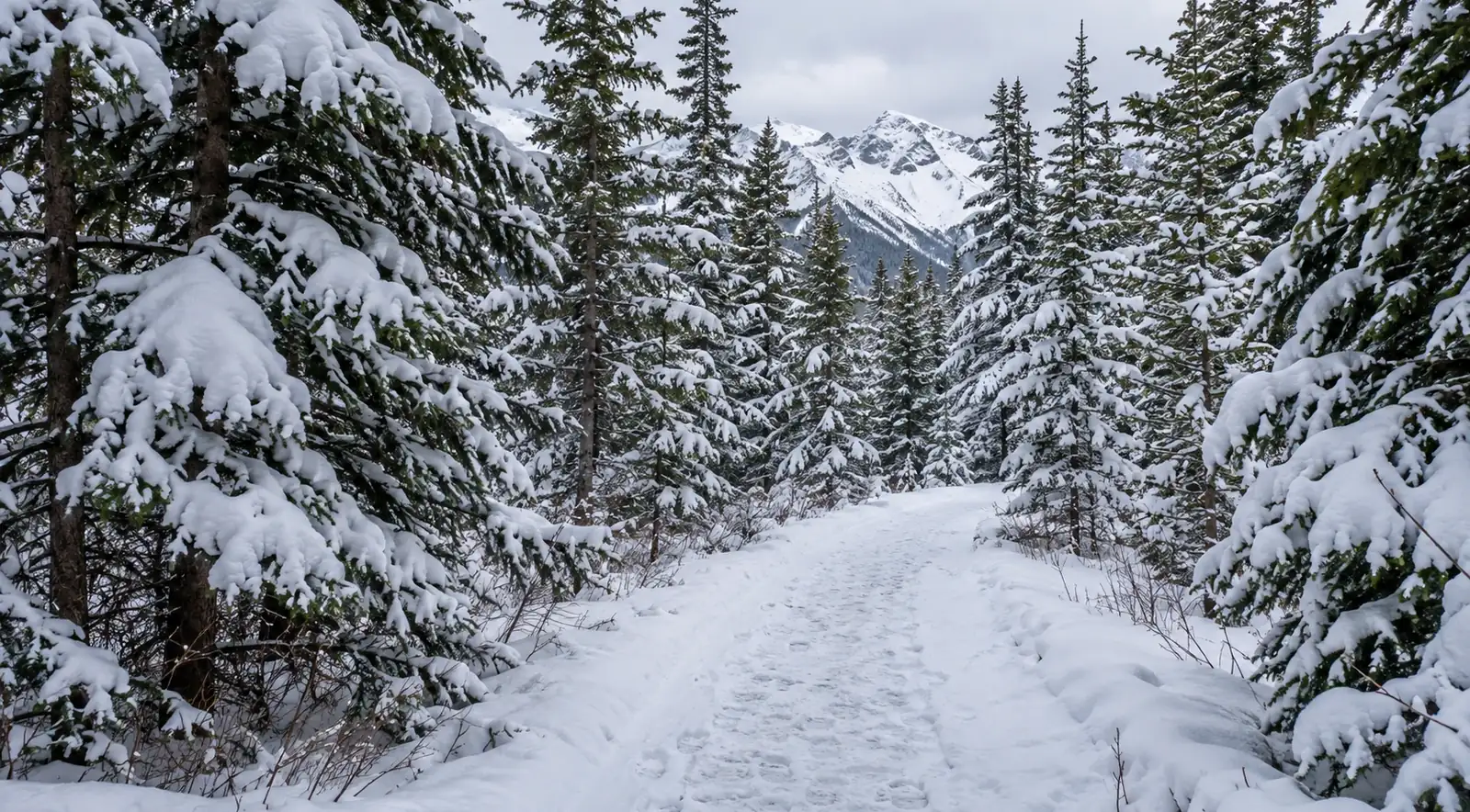
Fenland runs through mature spruce forest close to central Banff. Snow gathers on the branches and muffles the town, so you get a peaceful walk without a long transfer or a climb. The forest is the draw: small creek views, animal tracks, winter birds and dark trees against white snow.
Parks Canada lists Fenland as an easy winter walking route, but packed snow can turn icy, so carry ice cleats. The parking lot is off Mount Norquay Road, roughly 1.5 km or 20 minutes on foot from downtown. Without a car, add a stroll along the Bow River.
Who it suits: first-time winter hikers, families and walkers who want a good hour outside with no mountain exposure.
2. Marsh Loop: wetlands and wildlife tracks
2.8 km loop · minimal climb · near Cave and Basin · about 45–75 minutes
This loop mixes marshland, forest and open views of the Bow Valley. The snow keeps the tracks of deer, elk and smaller animals, and birdwatching can be good even in winter. The trail is gentle, but expect icy or wet patches when temperatures swing. Most people start from the Cave and Basin parking area.
Cave and Basin National Historic Site is next door and makes a warm indoor stop on its opening days. Roam's Route 4 bus to Cave and Basin ended its 2026 season on October 4, so walk there from town or arrange a local transfer; there is no winter Route 4.
Who it suits: wildlife fans, couples and families who want a quiet, inexpensive outing.
3. Spray Connector: forest and water by the Spray River
2 km one way · a return can approach 4 km, plus the walk to the trailhead · about 1–2 hours
Near Bow Falls, this gentle route links the Spray River East and West trails by a scenic bridge. From the Bow Falls Day-use Area, follow the signed connection via Golf Course Road and the Spray River East trailhead. Running water and forest give it a different feel from the famous lakes. The path can be icy, and if you start downtown, add the extra distance to the trailhead.
You don't need to finish the full return if the cold or the footing gets uncomfortable; turn around when you've had enough. Use the Parks Canada map, not a summer walk description.
Who it suits: active beginners who like rivers and forest and don't mind a little more distance.
4. Stewart Canyon: an easy canyon viewpoint
1.5 km one way · little climb · Lake Minnewanka Day-use Area · about 1–1.5 hours return
The Stewart Canyon walk follows the Cascade River to a bridge over a rocky canyon. Dark flowing water, ice along the banks and snowy forest make it especially photogenic in winter. Parks Canada warns that parts of it can be extremely icy, so wear ice cleats.
Getting there is the problem without a car. Roam's Route 6 to Lake Minnewanka and Johnson Lake is a summer service that ended on October 4 and does not run in winter 2026–27, so you need a winter-equipped vehicle or arranged transport. The western section of the Lake Minnewanka Loop Road is also closed from November to May; use only the open road access. Without a car, the Wildlife and Sightseeing Minibus Tour (★ 4.6, 150+ reviews, from $63) stops at Lake Minnewanka, though not for the canyon walk. If you are driving, read our guide to driving in Banff in winter first.
Who it suits: visitors with a car who want a short canyon walk, not a demanding hike.
5. Johnson Lake Loop: good for families with a car
2.8 km loop · mostly gentle · Johnson Lake Day-use Area · about 1–1.5 hours
Johnson Lake's shoreline trail gives you forest, open water or forming ice, and views toward Cascade Mountain and Mount Rundle. It is a manageable family circuit, although winter surfaces can be slippery and snow can hide parts of the path. With younger children, walking partway and turning back is often easier than committing to the whole loop.
The lake is about 11 km from Banff. The summer Route 6 bus doesn't run in winter, so you usually need a car or other transport.
Who it suits: families who want mountain-lake scenery without a real climb.
6. Lake Louise Lakeshore: the biggest mountain views
2.3 km one way · easy-rated designated sections · about 1–2.5 hours, depending on how far you go
From the lakeshore beside the Fairmont Chateau, the route follows Lake Louise toward Victoria Glacier. In November the water may still reflect the white peaks; by January the lake is normally frozen and covered in snow. You can see the famous view without hiking at all, then walk only as far as the designated winter route allows. Roam Route 8X runs to the Lake Louise lakeshore year-round. Our Lake Louise in winter guide covers the rink, the sleigh rides and when the lake freezes.
This is the most important safety warning on this page: routes around Lake Louise pass near avalanche terrain. Parks Canada flags the slopes of Mount Fairview beyond the boathouse and dangerous ground beyond the far end of the lake. Stay out of signed hazard areas; the summer Plain of Six Glaciers trail is not a casual winter extension. Don't walk on lake ice nobody has checked, or under frozen waterfalls.
Who it suits: first-time visitors after the most impressive scenery who will keep to the current winter route limits.
7. Fairview Lookout: short but steeper
1.2 km one way · about 105 m elevation gain · Lake Louise · about 1–1.5 hours return
This trail climbs through forest to a higher view of the Fairmont Chateau and Lake Louise. Photographers and active walkers love the panorama, but the climb is noticeably harder than Fenland, whatever the easy rating says. Ice cleats can make a real difference here.
Take the out-and-back route only. Parks Canada warns that the Fairview Lookout loop option enters avalanche terrain and needs avalanche training and equipment, so ignore summer loop suggestions in winter. If climbing on ice makes you uneasy, stay on the lower lakeshore viewpoint.
8. Tunnel Mountain Drive: an easy-rated snowshoe route
2 km one way · hilly, about 130 m of ascent and 135 m of descent on the listed route · near St. Julien Road
The section of Tunnel Mountain Drive closed to cars in winter becomes a broad snowshoe and walking corridor with glimpses of Cascade Mountain. It isn't a flat forest loop, so allow time for the hills. Snowshoes help after a fresh deep snowfall, while boots and ice cleats suit packed or icy days; follow the current route and grooming guidance.
Don't confuse it with Tunnel Mountain Summit, a separate moderate trail of about 2.4 km one way with 260 m of climbing. The summit trail can get very icy and is not our first choice for a beginner.
9. Bow River walk: the no-car option
Flexible 1–3 km suggested route · central Banff · about 30–75 minutes
Start around Central Park and follow a stretch of the Bow River pathway. The river, the snowy banks and the mountains behind make a pretty short walk without heading out to a remote trail. This is our suggested local walk, not one officially measured winter trail. Keep to the maintained sections, stay away from the river's edge and turn back if conditions get worse. Continue toward Bow Falls only on paths that suit the day's ice and snow.
Can You Hike in Banff in November?
Yes, especially on lower-elevation routes such as Fenland, the Marsh Loop and the town paths. November is unpredictable: the same trail can go from bare ground to frozen mud, ice and fresh snow within a week, and Lake Louise is usually much colder than town. On 14 November 2026, Parks Canada's report listed Fenland and the Marsh Loop as wet and muddy, Stewart Canyon as icy with cleats advised, and the Lake Louise lakeshore and Fairview Lookout as snow-covered with icy sections. Check the Parks Canada trail conditions on the day. Our Banff in November guide covers the rest of the month.
Johnston Canyon is closed. Parks Canada has closed its main trail, the day-use area and the P1 parking lot from October 13 to December 11, 2026, for rock-slope safety work, so don't plan it as a November beginner hike, even though older guides list it. Once it reopens, the Morning or Afternoon Johnston Canyon Icewalk (★ 4.8, 280+ reviews) includes ice cleats and transport; our Johnston Canyon ice walk guide has the details.
Do You Need Snowshoes or Ice Cleats?
On the popular easy trails, ice cleats are usually more useful than snowshoes. Snowshoes spread your weight over deep, soft snow; ice cleats or microspikes grip slippery, compacted surfaces. Hiking poles add balance. Neither makes avalanche terrain safe. Parks Canada also asks you to keep off groomed winter trails in soft conditions and to switch to snowshoes when your boots start leaving deep holes.
| Surface | What to wear |
|---|---|
| Mostly clear pathway | Winter boots |
| Compacted snowy trail | Boots, plus traction if it is slick |
| Polished ice | Ice cleats or microspikes |
| Deep soft snow | Snowshoes |
| Steep, technical icy slopes | Not a casual beginner route |
Also bring waterproof insulated boots, thermals, a warm jacket, gloves, a hat, warm socks, a water bottle, a snack, a charged phone, a headlamp and emergency items suited to the distance and the conditions.
Avalanche, Ice and Wildlife Safety
Stay on designated winter paths and turn around at posted warning signs. Avalanche season generally runs from November to June, and some popular summer routes near Lake Louise, including Lake Agnes, the Plain of Six Glaciers and Saddleback, cross dangerous winter terrain. Don't follow a summer app route across open slopes unless you are trained and equipped for avalanche terrain. Never assume a frozen lake is safe. Give wildlife plenty of space, carry bear spray where it is recommended and know how to use it. Short days and severe cold make an early start the safer choice. Parks Canada's Lake Louise avalanche safety page maps the hazard areas.
Can You Hike Without a Car?
Yes. Fenland, the Bow River and some other town routes are walkable from central hotels, and the Lake Louise lakeshore is on Roam's year-round Route 8X. Stewart Canyon and Johnson Lake usually need a car or arranged transport, because the summer Route 6 bus doesn't run in winter. Staying near Banff Avenue cuts down on transfers. For Lake Louise with a guide, the Emerald Lake, Moraine, Louise, Johnston Canyon & Banff Town tour (★ 4.8, 2,400+ reviews, from $70) runs through the winter and swaps Moraine Lake for Banff town from October 13 to May 31. Our guide to Banff in winter without a car has the winter bus routes and fares.
Is a Guided Winter Hike Worth Booking?
Not for an easy public loop near town. Walk Fenland or the Marsh Loop on your own if you are prepared and conditions allow. A guide earns the fee when the trip includes equipment, instruction, a route you wouldn't find yourself and the transport to get there.
Discover Banff Tours' Paint Pots snowshoe trip is a beginner-friendly four-hour outing in Kootenay National Park, usually advertised from December to April from around CA$99 per adult, with snowshoes, poles and transfers included. On GetYourGuide it is sold as the Snowshoeing Tour in Kootenay National Park (★ 5.0, 40+ reviews). It is a different day from a free walk in town: you travel to a quieter valley and learn a new winter skill.
A One-Day Easy Winter Walking Itinerary
- Morning: the 2.1 km Fenland Trail loop.
- Late morning: coffee in town and a short Bow River walk.
- Afternoon: the Marsh Loop near Cave and Basin, or the historic site itself if the paths are icy.
- Evening: dinner in town and, if they are open, the Banff Upper Hot Springs.
For mountain scenery, give Lake Louise its own half day instead of squeezing it into the same walking day.
Easy Winter Hikes in Banff: FAQ
What is the easiest winter hike in Banff?
The Fenland Trail, a mostly flat 2.1 km loop close to downtown Banff, is our first recommendation.
Do beginners need a guide?
Not for the designated easy paths, as long as you check conditions and have the right footwear. A guided tour helps on unfamiliar terrain and when you need equipment.
Can I hike in November?
Yes, on lower-elevation routes such as Fenland and the Marsh Loop, but let ice, snow and avalanche-related closures guide where you go.
Can I go hiking without snowshoes?
Often, yes. On hard-packed or icy trails, winter boots and ice cleats suit better than snowshoes.
Is Tunnel Mountain Summit easy in winter?
No. It is officially a moderate trail, climbs about 260 m and can become extremely icy. Choose Tunnel Mountain Drive or Fenland for an easier outing.
Is Lake Louise suitable for beginner winter hikers?
Parts of the designated lakeshore route can be, when conditions allow. Do not continue into signed avalanche terrain.
Are these hikes free?
There is no separate trail fee, but national park admission, transport and gear can cost money.
Official Resources
Official resources: Parks Canada: Banff winter walking, Parks Canada: Banff snowshoeing, Parks Canada: Lake Louise winter walking, Parks Canada: Lake Louise avalanche safety, Parks Canada: current trail conditions, Roam Transit and Avalanche Canada.
Trail figures (distances, elevation gain and the avalanche warnings for Fairview Lookout and the Lake Louise lakeshore) are from Parks Canada's winter walking and snowshoeing pages, and the Johnston Canyon dates from its closure bulletin, checked on 14 November 2026. Roam's route end dates are from its 2026 fall and winter schedule changes. Trail conditions and closures can change quickly.
Tours: GetYourGuide ratings and review counts were checked on 14 November 2026. Dollar prices are GetYourGuide "from" figures.