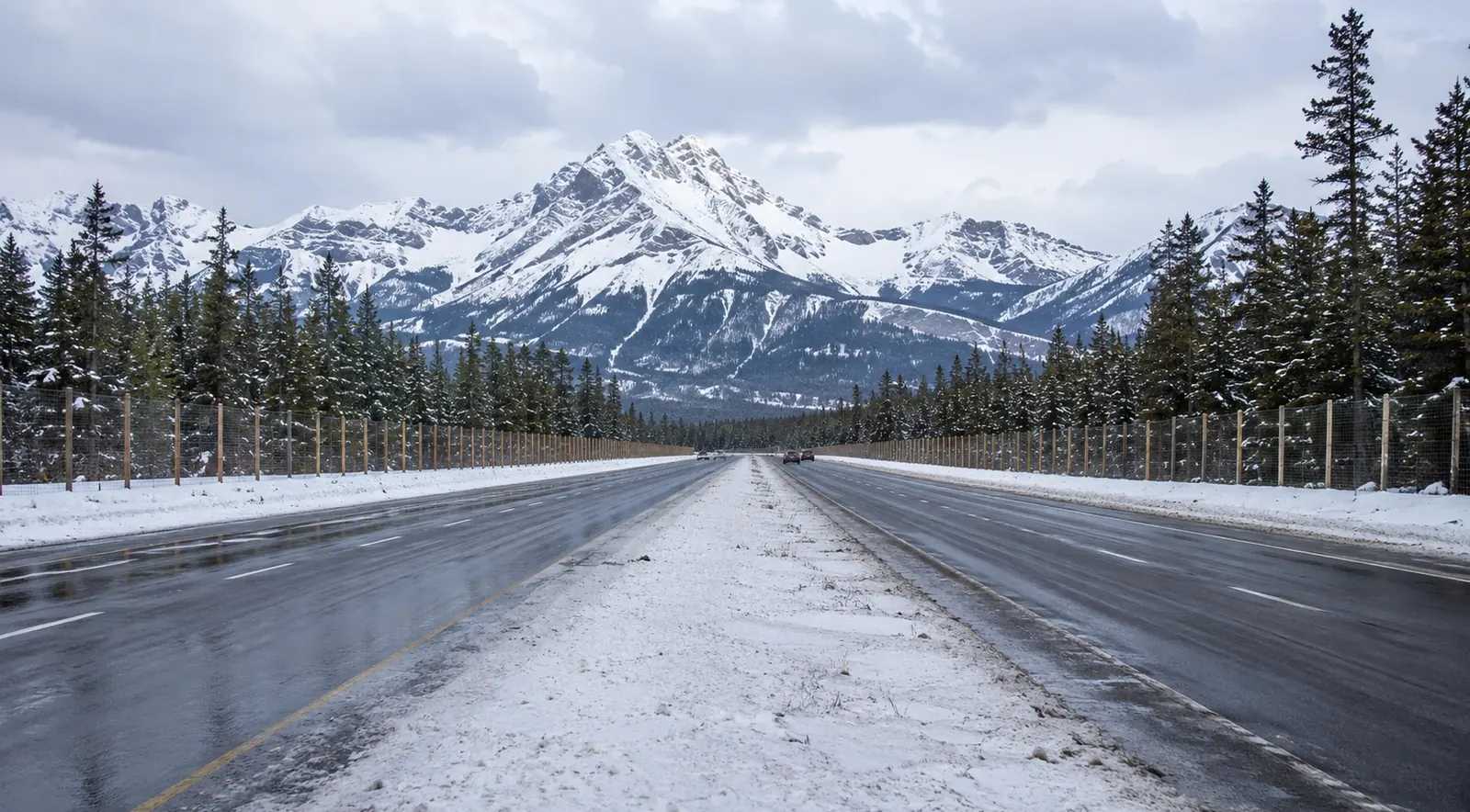
- 1.5–2 hCalgary Airport to Banff in good conditions, 140–145 km
- Nov 1–Mar 31snow tires or chains on Hwys 93N and 93S in Banff National Park
- Oct 1–Apr 30the same rule on Hwy 93S in Kootenay and Hwy 1 in Yoho
- 232 kmIcefields Parkway, with no services in winter
- CA$7/hdowntown Banff parking, November 1 to April 30
Do You Need a Car in Banff in Winter?
A rental car gives you freedom, but not every winter visitor needs one. You can take a shuttle from Calgary Airport, stay centrally in Banff, ride Roam buses to the gondola and Lake Louise, and use guided tours for the more remote viewpoints.
Our recommendation: if you are staying in central Banff and mainly want the gondola, the town and Lake Louise, you probably don't need a car, and a car-free visit is often easier. If you want several quiet viewpoints, or you are staying in Canmore, a properly equipped rental car adds flexibility.
YYC Airport Shared Shuttle to Banff
A shared shuttle takes the winter highway off your hands after a long flight. You are collected at Calgary International Airport and dropped in Banff, so you can arrive after dark or in a snowstorm without driving an unfamiliar car on ice.
It makes most sense if you are staying in central Banff and plan to use buses and tours once you are there. If you are staying at Lake Louise, the Calgary Airport Transfer to Canmore, Banff and Lake Louise (★ 4.9, 55+ reviews) goes all the way there.
Rating and review count checked on GetYourGuide, 14 November 2026; the price is GetYourGuide's from-price converted to US dollars. Free cancellation up to 24 hours before.
Driving in Banff in Winter: Quick Facts
| Question | Answer |
|---|---|
| Calgary–Banff road | Highway 1, a major year-round route that can close in storms |
| Calgary Airport to Banff | Roughly 140–145 km; 1.5–2 hours in good conditions |
| Banff to Lake Louise | Around 55–60 km; 40–50 minutes in good conditions |
| Winter tires required everywhere? | No Alberta-wide rule for passenger cars; required on specified mountain park roads |
| Icefields Parkway rule | Snow tires or chains November 1 to March 31, and whenever snow or ice covers the road |
| Is 4WD essential? | No; proper tires and the conditions matter more |
| Can you drive to Lake Louise? | Yes, road and weather permitting |
| Can you drive to Moraine Lake? | No ordinary personal-vehicle access |
| Free parking in Banff? | Up to nine hours in designated lots, including the train station lot |
| Need a car to visit Banff? | No: airport shuttles, Roam buses and guided tours cover the main sights |
Other Experiences You Might Enjoy
Let someone else drive: Calgary Airport shuttles to Banff and Lake Louise, guided winter days to Lake Louise and Emerald Lake in Yoho, wildlife tours to Lake Minnewanka, icewalks in Johnston Canyon, snowshoeing in Kootenay National Park and the Banff Gondola.
Is the Calgary–Banff Drive Safe in Winter?
In good conditions it is a fairly easy drive. It follows Highway 1, a major route used by commuters, shuttles, trucks and tourists, with no endless narrow switchbacks or exposed cliff roads. Maintenance crews work on it all winter.
Open doesn't mean clear, though. The western approach from Calgary gets wind and drifting snow, and shaded mountain stretches can hold ice. A mild afternoon in Calgary says nothing about the road at Lake Louise. If you are not used to driving on snow, take an airport shuttle during storms or after a late-night flight.
Check Alberta 511 just before you leave for incidents, closures, road-surface reports, cameras and weather alerts. Don't rely on a screenshot or a forecast from the night before. Our Calgary to Banff guide covers every way to make the trip.
Calgary Airport to Banff: Route and Timing
The usual route is Calgary Airport → Stoney Trail (Highway 201) → Trans-Canada Highway 1 West → Canmore → Banff. It generally takes 1.5–2 hours in good conditions, and much longer in severe weather. Canmore is a handy stop for fuel or lunch before Banff, but you don't have to stop.
| Journey | Approx. distance | Time in good weather |
|---|---|---|
| Calgary Airport–Banff | 140–145 km | 1.5–2 h |
| Calgary centre–Banff | 125–130 km | About 1.5 h |
| Canmore–Banff | 25 km | 20–30 min |
| Banff–Lake Louise | 55–60 km | 40–50 min |
| Banff–Jasper via the Icefields Parkway | About 285 km | 4–5+ h before any long stops |
These are planning estimates, not winter travel times. Drive long stretches in daylight where you can: near the December solstice, Banff gets only about eight hours of it.
Winter Tire Requirements: Which Roads Need Them
Alberta has no province-wide rule requiring passenger cars to use winter tires, but Parks Canada rules apply on some mountain park highways, and the roads into British Columbia start their season a month earlier.
| Road | Legal or practical rule |
|---|---|
| Highway 1, Calgary to Banff (Alberta) | No seasonal winter tire mandate on the whole route; strongly recommended |
| Icefields Parkway (Highway 93N) | Snow tires or chains November 1 to March 31, and whenever snow or ice covers the road |
| Banff–Windermere Highway (93S in Banff National Park) | Snow tires or chains November 1 to March 31, and in snow or ice |
| Highway 93S in Kootenay National Park (B.C.) | Snow tires or chains October 1 to April 30 |
| Highway 1 in Yoho National Park (B.C.) | Snow tires or chains October 1 to April 30 |
| Any posted route | Follow its own regulations and signs |
M+S or the three-peak mountain snowflake?
M+S means mud and snow. Many all-season tires carry it, and it can meet the legal minimum on some routes. The three-peak mountain snowflake (3PMSF) marks tires that pass a defined severe-snow traction test. For a winter trip in the Rockies, ask for four matching winter tires with the 3PMSF symbol where you can get them. British Columbia also sets a minimum tread depth of 3.5 mm for a legal winter tire. Check the latest rules for your route.
Do you need tire chains?
Usually not, if your car has compliant snow tires, though some specified roads accept tires or chains. Many rental agreements restrict chain use, and an icy roadside is a bad place to fit chains for the first time.
AWD or 4WD vs Winter Tires
A front-wheel-drive car on good winter tires can be the right choice on maintained roads in suitable conditions. AWD helps you accelerate, but it does not shorten your stopping distance on ice. Tires, braking, following distance, visibility and your own judgment matter more. An AWD SUV on worn all-season tires isn't necessarily safer than a small car on good winter tires.
| Vehicle setup | Our view |
|---|---|
| Sedan with four winter tires | A good option in suitable conditions |
| FWD hatchback with winter tires | Often adequate for the main roads |
| AWD SUV with proper winter tires | Useful traction and luggage space |
| AWD on worn or unsuitable tires | A poor choice |
| Any vehicle during a road closure or severe storm | Don't drive |
Renting a Car in Calgary: Questions to Ask
Before you pay for a Calgary Airport rental, get written confirmation of:
- 1. Whether four proper winter tires are fitted and guaranteed.
- 2. Whether winter tires cost extra.
- 3. The tire markings and tread condition.
- 4. Permission to drive Highway 93N and into British Columbia.
- 5. The collision damage terms and excess, and whether tires and windshields are excluded.
- 6. Breakdown cover, roadside assistance and towing rules.
- 7. Additional drivers and child seats.
- 8. Charges for weather delays and late returns.
Rental companies do not fit dedicated winter tires to every Calgary car, and a requested upgrade isn't always a guarantee. Compare the total cost, including insurance, airport fees, hotel parking and fuel, not just the cheapest daily rate.
International visitors need a valid driver's license accepted under Alberta rules, and may also need or benefit from an International Driving Permit, depending on the language of the license and the rental company's policy. The permit does not replace your original license.
Road Conditions by Winter Month
| Month | What to expect on the road |
|---|---|
| November | Transition conditions: snow, meltwater and overnight freezing can produce black ice. Town may be mostly bare while Lake Louise and the mountain highways are wintry. |
| December | Short days, colder temperatures and holiday traffic. Leave more time for transfers. |
| January | Deep cold, lasting ice in shaded spots and temperatures that can fall far below −20°C. Keep warm clothing inside the car. |
| February | Settled winter snow, though severe storms are still possible; longer days don't remove the risks. |
| March | Longer days, but freeze–thaw cycles and overnight refreezing can make roads very slick. Winter equipment still matters. |
A month's reputation matters less than the day's official road report.
Driving From Banff to Lake Louise in Winter
Lake Louise is reachable year-round on Highway 1 and Lake Louise Drive, subject to the weather and temporary restrictions. It is higher than Banff and usually colder. Parking near the lakeshore is still limited, although Parks Canada's 2026 paid-parking season ran from May 15 to October 12, so the seasonal lot fee doesn't apply in winter. Park entry is a separate charge; our park pass guide has the fees.
If you'd rather not drive, Roam's Route 8X runs to the lakeshore through the winter, a real alternative to renting a car. Another option is a guided day: the Emerald Lake, Moraine, Louise, Johnston Canyon & Banff Town tour (★ 4.8, 2,400+ reviews, from $70) runs all winter, adds Emerald Lake in Yoho and swaps Moraine Lake for Banff town from October 13 to May 31. Our Lake Louise in winter guide covers what to do once you arrive.
Moraine Lake is different: personal vehicles aren't allowed on Moraine Lake Road, the seasonal shuttles end in the fall, and avalanche hazard restricts winter access to the lake itself.
The Icefields Parkway in Winter
The Icefields Parkway (Highway 93N) runs about 232 km from Lake Louise to Jasper through remote Rocky Mountain terrain. It can be spectacular in winter, but it is not a beginner's scenic detour.
- Snow tires or chains are required from November 1 to March 31, and whenever snow or ice covers the road.
- There are no services between Lake Louise and Jasper in winter; the seasonal facilities at Saskatchewan River Crossing are closed.
- There is little or no cell service along most of the route, so download your maps.
- Snow clearing generally runs from 7 am to 3:30 pm, not around the clock.
- Storms and avalanche-control work can close the road temporarily.
- Compacted snow can stay on the road even after clearing.
Fill the tank, carry emergency gear and be ready to cancel. A full Banff–Jasper–Banff day in winter is not a sensible plan for a first-time winter driver. A short section of the Parkway may work in good conditions, but decide on the day. Our Icefields Parkway guide covers the stops.
Roads and Attractions With Seasonal Closures
| Place or road | Winter rule |
|---|---|
| Highway 1 | Open year-round; temporary disruptions possible |
| Icefields Parkway | Can be open; closures for weather and avalanche control |
| Moraine Lake Road | No ordinary sightseeing vehicle access |
| Lake Minnewanka Loop Road | Western section closed November to May |
| Golf Course Road near the Banff Springs | Seasonal closure |
| Bow Valley Parkway | Various wildlife, seasonal and construction restrictions |
| Yoho Valley Road to Takakkaw Falls | Closed for the winter season |
| Johnston Canyon | Main trail, day-use area and P1 lot closed October 13 to December 11, 2026 |
Be wary of summer routes on Google Maps: a road on the map isn't proof of winter access. Once Johnston Canyon reopens, the Morning or Afternoon Johnston Canyon Icewalk (★ 4.8, 280+ reviews) drives you there; see our Johnston Canyon ice walk guide.
Winter Driving Safety Checklist
- Slow down, leave a bigger gap and brake gently.
- Expect black ice on bridges, in shade and after freeze–thaw cycles.
- Don't use cruise control on slippery roads.
- Give snowplows plenty of room and never overtake through a snow cloud.
- Clear snow and ice from the windows, lights, roof and license plate.
- Use winter-rated washer fluid, working headlights and proper tires.
- Never stop in a live traffic lane to photograph wildlife or scenery.
- Start remote drives with enough fuel, offline maps and warm supplies.
- Avoid driving at night in a storm unless you have to.
- Respect road closures, and turn around when conditions go beyond your experience.
What to carry
A warm coat, blanket, gloves, hat, water, food, a charged phone and power bank, a flashlight, a snow brush and scraper, a small shovel, a first-aid kit, warning or reflective equipment and your roadside assistance details. Add suitable emergency supplies for remote roads. If you get stuck, call emergency services where you can, stay with the car when that is safer, and make sure the exhaust pipe is clear before running the engine for warmth, to avoid carbon monoxide poisoning.
Parking in Banff During Winter
The Town of Banff keeps paid parking in winter: CA$7 an hour from November 1 to April 30 in the downtown pay zone, from 8 am to 8 pm. Free parking for up to nine hours is available in designated places, including the Banff Train Station public lot, some Bow Avenue stalls and the upper levels of the Bear Street parkade, subject to the signs. The train station lot is roughly an eight-minute walk from the center, but it isn't unlimited overnight parking.
Park entry fees and town parking charges are separate. Check whether your hotel includes parking before you reserve a car.
Visiting Banff in Winter Without a Rental Car
Airport shuttles: Banff Airporter and Brewster Express connect Calgary Airport with Banff. Brewster's winter schedule runs from November 1, 2026 to April 30, 2027. Banff Airporter lists an adult one-way fare of CA$88.90 from Calgary to Banff; check the price and times at checkout. On GetYourGuide, the YYC Airport Shared Shuttle to Banff (★ 4.4, 300+ reviews) is our pick, and the Calgary Airport Transfer to Canmore, Banff and Lake Louise suits a Lake Louise hotel.
Roam buses: Route 1 goes to the gondola and the Upper Hot Springs, Route 8X runs to Lake Louise through the winter, and local routes cover Banff town. The adult Route 8X fare is CA$12.50 one way, and a system-wide day pass, which you can reserve for the day, is CA$30; each reservation carries a CA$3 booking fee. Our guide to visiting Banff in winter without a car has the routes, fares and a car-free plan.
Guided tours: the easiest paid choice for Emerald Lake and Yoho, remote viewpoints, guided snowshoeing and, once the trail reopens, the Johnston Canyon icewalk. Look for hotel pickup and check that the tour runs on your dates. The Emerald Lake, Moraine, Louise, Johnston Canyon & Banff Town tour covers Lake Louise and Yoho in one winter day, and the Snowshoeing Tour in Kootenay National Park (★ 5.0, 40+ reviews) picks up in Banff.
Car or shuttle: which is cheaper?
For solo travelers and couples staying centrally, shuttles and Roam buses are often good value. For families or groups staying in Canmore, a rental can compete. Compare the total cost: rental, winter tires, insurance, fuel and parking against shuttle fares, local buses and guided tours. Skipping the winter driving has its own value too.
A Three-Day Winter Road Trip From Calgary
- Day 1: collect the rental at Calgary Airport and check the winter tires, look at Alberta 511, drive to Banff via Canmore and explore town if there is daylight left.
- Day 2: drive to Lake Louise for the view and a designated easy winter walk, and return to Banff in daylight.
- Day 3: Bow Falls and the Lake Minnewanka viewpoints you can reach on open roads, or the gondola. Add Yoho only if time, the tire rules and the conditions allow.
Don't make the Icefields Parkway a must on a short trip. Our Banff winter itinerary has longer 4- and 5-day plans.
Driving in Banff in Winter: FAQ
Is driving from Calgary to Banff safe in November?
Often, yes, in good conditions on the maintained Highway 1. Snow and ice are possible, though, so check Alberta 511 before you leave and be honest about your winter driving experience.
Do I legally need winter tires?
It depends on the road. Snow tires or chains are required on Highways 93N and 93S in Banff National Park from November 1 to March 31, and on Highway 93S in Kootenay and Highway 1 in Yoho from October 1 to April 30, as well as whenever those roads are snow- or ice-covered. Elsewhere they are strongly recommended.
Do I need four-wheel drive?
No. A two-wheel-drive car on good winter tires is usually fine on maintained roads in good conditions.
Is the Icefields Parkway open in December?
It can be, but storms and avalanche control can close it. Snow tires or chains are required, and there are no services along the route in winter.
Is downtown parking free in winter?
Not in the downtown pay zone, which charges CA$7 an hour from November 1 to April 30. Designated lots, including the train station lot, offer free parking for up to nine hours.
Can I visit Banff without a car?
Yes. Airport shuttles, Roam buses and guided tours make a car-free winter trip practical.
Can you drive to Moraine Lake in winter?
No. Personal vehicles are not allowed on Moraine Lake Road, and there is no winter sightseeing access by car.
Official Links
Official resources: Parks Canada: Banff driving, Parks Canada: Icefields Parkway in winter, Alberta 511, DriveBC, B.C. winter tire requirements, Town of Banff parking, Brewster Express, Banff Airporter and Roam Transit fares.
Rules, fares and dates (the winter tire periods, the Icefields Parkway clearing hours, Banff's parking rates, the Lake Louise paid-parking season, the Minnewanka Loop Road closure, the Airporter and Roam fares and Brewster's winter schedule) are the published 2026–27 figures, checked on 14 November 2026. Road conditions change by the hour, so never treat a static page as proof that a road is open or safe.
Tours: GetYourGuide ratings and review counts were checked on 14 November 2026. Dollar prices are GetYourGuide "from" figures.