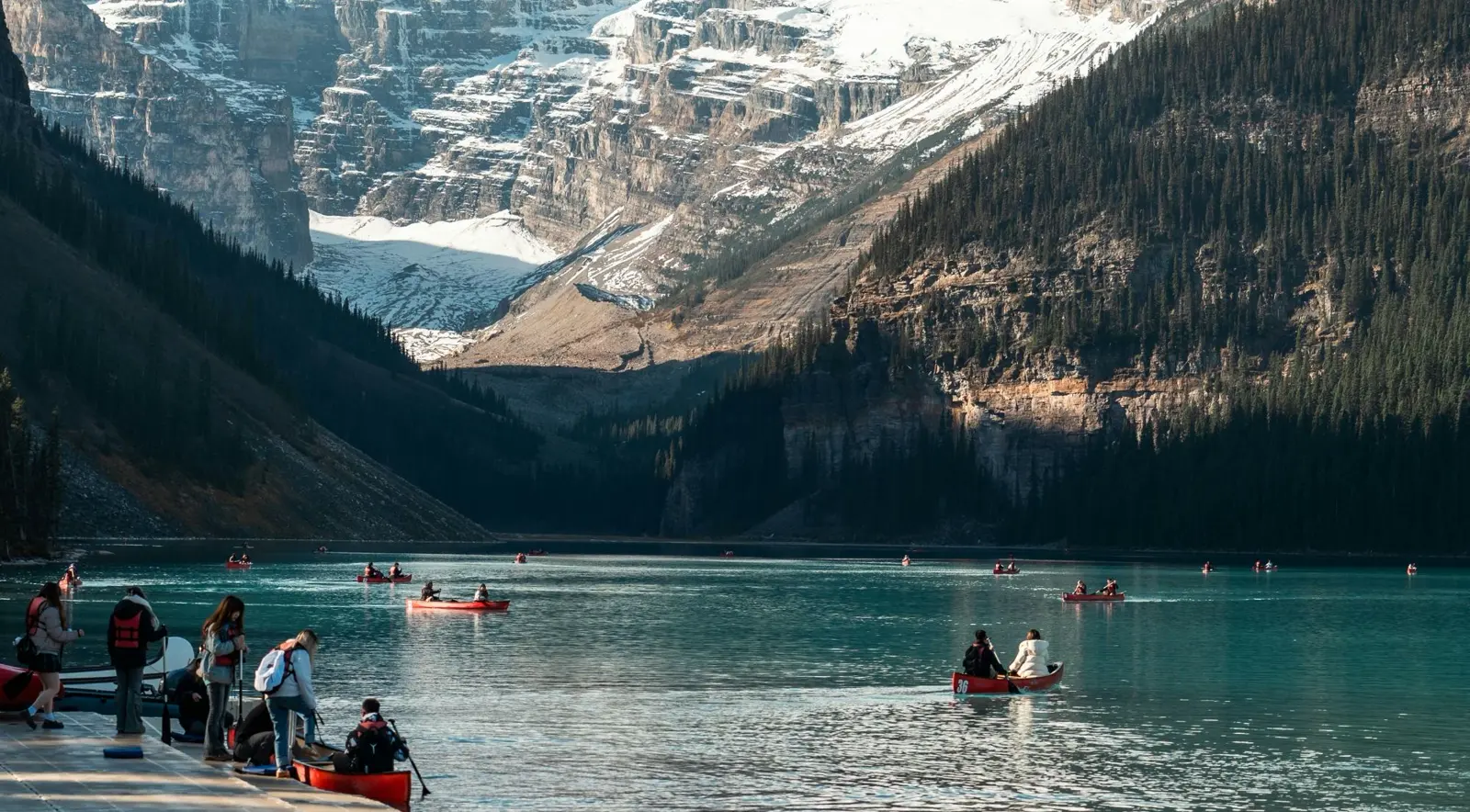
What Changed for Paddlers in 2026
New restrictions tied to whirling disease, an invasive parasite that affects fish, now limit private watercraft on several of the park's most popular lakes. This guide covers where you can still canoe, what changed, where to rent, and how to plan a paddling day that works under the current rules.
Read the whole guide before you pack a canoe or book a rental. The rules below rule out some of the most obvious choices, including bringing your own boat to Moraine Lake or Lake Minnewanka, and Parks Canada says they may change again.
Banff/Canmore: Moraine Lake with Lake Louise Option
Moraine Lake has no car access, so a tour is one of the simplest ways to reach its canoe dock. This small-group tour gives you up to two hours at Moraine Lake and, on the daytime option, another two hours at Lake Louise: enough time to rent a canoe at one lake and walk the shore at the other. Pickup runs from Banff, Canmore and Harvie Heights in vans seating 14 or 22, and park entry and the Moraine Lake Road access fee are included.
Rating and review count are GetYourGuide figures from our latest data pull (30 June 2026); a live re-check was rate-limited at build time. Free cancellation up to 24 hours before. Canoe rental is not included and is paid at the dock. Shared departures need at least four guests to run; if the minimum is not met you are offered another date or a full refund.
Current Paddling Restrictions: What You Need to Know
Whirling disease is a parasitic disease that affects fish, particularly trout and salmon, and Parks Canada says it can kill up to 90% of young fish. It was first confirmed in Canada at Johnson Lake in Banff in August 2016, and it was reported in Lake Louise in 2025. The restrictions target private watercraft (the canoes, kayaks and paddleboards visitors bring themselves), because water, mud and plant material carried on a boat or its gear can move the parasite from one lake to the next.
Under a Restricted Activity Order issued in April 2026, every lake and river in Banff now falls into one of three zones:
| Zone | Waters | Private canoes & kayaks |
|---|---|---|
| Water Recreation Zone | Lake Louise, Two Jack Lake, Vermilion Lakes, Johnson Lake, Herbert Lake, Cascade Ponds and the Bow River downstream of Hector Lake, among others | Allowed with a self-certification permit or inspection; no motorboats |
| Water Preservation Zone | Moraine Lake, Bow Lake and every water body not listed in another zone | Banned. At Moraine Lake only on-site rental canoes that never leave the lake are allowed |
| Special Tactics Zone | Lake Minnewanka only | Banned; lakeshore rentals allowed; private motorboats allowed after inspection |
Clean, Drain, Dry rules apply across the park, whichever zone you are in, as a standard invasive-species prevention practice. Your canoe and everything that touched the water (paddles, life jackets, waders) must be cleaned, drained of all water and completely dried before it moves to another water body. Where private paddling is allowed you also need an Aquatic Invasive Species self-certification permit or a staffed inspection, and gear last used in Alberta, B.C., the Northwest Territories or Yukon must have been dry for 48 hours; gear used anywhere else, for 30 days. Parks Canada takes this seriously: breaking the rules can bring a fine of up to $25,000 under the Canada National Parks Act.
The zones can change as monitoring continues, so check the Banff bulletins on the official Parks Canada website before your trip, and again just before you paddle. Do not rely on any single source, this guide included, without checking.
Other Experiences You Might Enjoy
Plenty to pair with a paddle: tours to Moraine Lake and Lake Louise, the Lake Minnewanka boat cruise, scenic Bow River floats in Canmore, day trips to Emerald Lake in Yoho National Park, and whitewater rafting on the Kananaskis and Kicking Horse rivers.
- 3lakes closed to private canoes: Moraine, Bow, Minnewanka
- $180per hour, Lake Louise canoe (non-hotel guests)
- $70first hour, Banff Canoe Club on the Bow River
- 48 hdrying time for gear last used in AB, BC, NWT or YT
- $25,000maximum fine under the Canada National Parks Act
Lake Minnewanka: Boating and Canoeing
Lake Minnewanka has long been the most flexible lake in the park for boats. It is the only lake in Banff National Park where motorboats are permitted, a rarity in a park where most lakes allow non-motorized craft only.
In 2026 it has its own zone. Private canoes, kayaks, paddleboards and large inflatables are banned, but private motorboats are still allowed if they pass a Parks Canada inspection, which you book at least 48 hours ahead (403-497-5821). The rental boats at the lakeshore boathouse stay on the lake, so they are still permitted: in 2026 a canoe or double kayak costs CAD $130 for the first hour and $48 for each extra hour, a single kayak $65 and then $26, and a motorboat $205 and then $84, all plus GST. The boathouse opens at 9 a.m. in peak summer (June 12 to August 31) and at 10 a.m. in spring and autumn, and the season ends on October 12.
The Lake Minnewanka cruise (★ 4.7, 1,004 reviews, from $56) runs independently of the private watercraft rules, and it is the easiest way onto the water if paddling is not the point. Our Lake Minnewanka guide covers the lake in full.
Canoe Rental Options in Banff
If you do not want to bring or transport your own canoe, renting is the simpler option under the current rules. Rental fleets stay on one lake or river, so there is no gear moving between water bodies and no permit to arrange.
| Where | 2026 price (CAD, plus GST) | Good to know |
|---|---|---|
| Lake Louise (Fairmont boathouse) | $180 per hour for non-hotel guests; $110 for hotel guests | Daily 10 a.m.–5 p.m.; first-come, first-served |
| Moraine Lake (Moraine Lake Lodge dock) | From $160 per hour | Roughly mid-June to mid-September; canoes hold two to three people; lodge guests paddle free |
| Lake Minnewanka boathouse | Canoe or double kayak $130 first hour, then $48 | Also single kayaks and motorboats; season ends October 12 |
| Banff Canoe Club (Banff townsite) | $70 per boat first hour, then $35; $15 for a third person | Bow River, or Forty Mile Creek into Vermilion Lakes; no reservations |
| Emerald Lake, Yoho (Boathouse Trading Co.) | $100 per hour | Life jackets included and must be worn; 10 a.m.–4:45 p.m. |
Rental availability depends on the restrictions above, so confirm the operator is running before you plan a day around a canoe. An operator active last season may not be operating if the rules at that lake have changed, and every dock above closes in high wind or bad weather. None of these rentals can be booked through GetYourGuide; you pay at the dock. The Moraine Lake and Lake Louise tour above is the easy way to reach the two most famous docks without parking or a shuttle.
Alternative Paddling Locations
Water Recreation Zone lakes
If you have your own canoe and a self-certification permit, Vermilion Lakes, Two Jack Lake, Johnson Lake, Herbert Lake, Lake Louise and the Bow River below Hector Lake are open to paddling. Vermilion Lakes and the Bow are also where the Banff Canoe Club rentals go, so you can paddle there without a boat of your own. Local outfitters and Parks Canada can tell you which waters are open on your dates.
Emerald Lake, Yoho National Park
Just over the provincial border, Emerald Lake runs under Yoho's own rules, which do not mirror Banff's. Every water body in Yoho is closed to private watercraft and fishing until March 31, 2027, but the on-site rental canoes stay on the lake and are still running. A small-group Emerald Lake tour with an optional canoe (★ 4.7 from 22 reviews, from $91) builds the paddle into the day; it has a short review record, so read the recent reviews first.
A guided float on the Bow River
If you would rather someone else steer, a raft float is the gentlest way onto moving water. The Bow River scenic float in Canmore (★ 4.9, 474 reviews, from $42) leaves from the Canmore public boat launch, is suitable for all ages and needs no paddling experience.
Something faster
For white water instead of flat water, the Kananaskis River whitewater rafting tour (★ 4.9, 342 reviews, from $92) runs from Banff with guides and all the gear. It is a different day out from a quiet canoe: fast water, wetsuits and a guide at the back of the raft.
Planning Your Canoeing Day
Best time of day
Early morning usually brings the calmest water, before the wind picks up later in the day. The same is true for photography, as our Banff photography guide explains. Note that the Lake Louise boathouse does not open until 10 a.m., so the calmest hour there is for the shoreline, not the canoe.
Life jackets
Canadian law requires a properly sized lifejacket or PFD on board for every person in a canoe or other watercraft. Rentals include them (at Emerald Lake everyone must wear one), and if you bring your own canoe, pack a fitted PFD for each paddler.
Water temperature
Banff's glacial lakes are extremely cold all year, even at the height of summer. Dress for the water, not the air, know the risks of cold-water immersion, and never underestimate how quickly cold water becomes dangerous if you capsize.
Weather
Mountain weather changes quickly, and wind makes open water much harder and more hazardous to paddle. Check the forecast before you head out, and be ready to postpone or cut a paddle short if conditions turn.
Wildlife
Watch for wildlife, particularly along the shoreline, and follow the usual safety practices: stay at least 30 metres from elk, deer, sheep and moose and 100 metres from bears, wolves, cougars and coyotes.
Tips for Canoeing in Banff
- Check the current watercraft restrictions just before your trip. The rules are still changing, and this guide cannot replace the current Parks Canada bulletins.
- Clean, drain and dry your canoe and gear before moving between water bodies, even where private paddling is allowed.
- Rent at the lake you are paddling where you can, instead of moving your own canoe between lakes. It lowers the invasive-species risk and saves the permit.
- Go early in the day for the calmest water and the best light.
- Dress for cold water whatever the air temperature, and always wear a properly fitted life jacket.
- Watch the weather, because conditions on open water can change quickly.
Canoeing in Banff: FAQ
Can I canoe on Moraine Lake in 2026?
Only in a rental canoe. Moraine Lake is in Parks Canada's Water Preservation Zone, so private canoes, kayaks and paddleboards are banned; the only watercraft allowed are on-site rentals that never leave the lake, from the Moraine Lake Lodge dock (from CAD $160 plus GST per hour, roughly mid-June to mid-September). Check the Parks Canada bulletins page before you go, as the rules can change. Our Moraine Lake guide covers how to get there.
Why are there canoeing restrictions in Banff now?
To slow the spread of whirling disease, a parasitic disease of trout and salmon that can kill up to 90% of young fish. It can travel between lakes in water, mud or plant material carried on boats and gear. It was first confirmed in Canada at Johnson Lake in Banff in 2016 and was reported in Lake Louise in 2025.
Can I still canoe on Lake Minnewanka?
Not in your own canoe. In 2026 Lake Minnewanka is a Special Tactics Zone: private canoes, kayaks, paddleboards and large inflatables are banned, but you can rent a canoe or kayak at the lakeshore boathouse (CAD $130 for the first hour for a canoe or double kayak). Private motorboats are still allowed after a Parks Canada inspection booked 48 hours ahead.
Do I need to clean my canoe between lakes?
Yes. Clean, Drain, Dry rules apply across the park, and where private paddling is still allowed you also need an Aquatic Invasive Species self-certification permit or an inspection. Gear last used in Alberta, B.C., the Northwest Territories or Yukon must be dry for 48 hours; gear used anywhere else, for 30 days.
Where can I rent a canoe in Banff?
In 2026: the Fairmont boathouse at Lake Louise (CAD $180 per hour for non-hotel guests), the Moraine Lake Lodge dock (from CAD $160 plus GST per hour), the Lake Minnewanka boathouse (CAD $130 for the first hour), and the Banff Canoe Club in town for the Bow River and Vermilion Lakes (CAD $70 for the first hour). Emerald Lake in Yoho rents canoes for CAD $100 per hour.
Is it safe to canoe on Banff's glacial lakes?
With a properly fitted life jacket, awareness of how cold the water is and attention to the weather, canoeing is a popular and generally safe activity. Conditions can change quickly, though, so take them seriously and head back to shore if the wind rises.