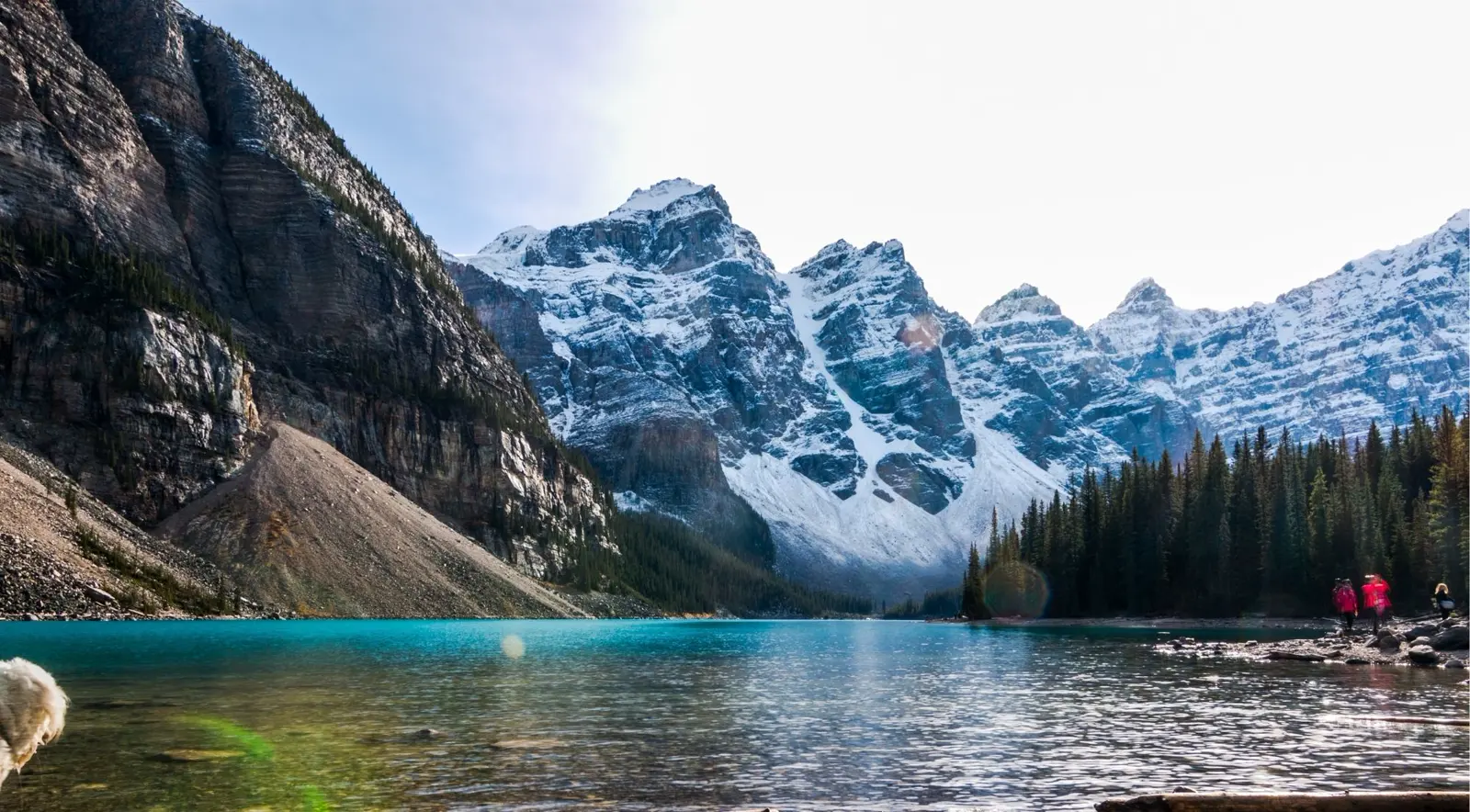
There Is No Single "Best Lake in Banff"
Moraine Lake wins on raw wow-factor; Lake Louise wins on iconic status; Peyto wins on the classic Icefields Parkway view; the Vermilion Lakes win for a free five-minute sunset; and hike-in lakes like Boom and Taylor win for solitude. Below, we rank them and then compare them head-to-head so you can decide.
One 2026 note up front: under the Canada Strong Pass, admission to Banff National Park is free from June 19 to September 7, 2026, inclusive (Parks Canada also offers a 25% discount on camping during that window); regular adult admission resumes at C$12.25 per day afterward. Free entry does not remove shuttle reservations, paid parking or capacity limits — we cover those specifics lake by lake. Full detail is in our Banff National Park pass guide.
Louise, Moraine, Emerald & Peyto: The 4-Lakes Tour
The single most efficient answer to this entire page. It covers Lake Louise (No. 2), Moraine Lake (No. 1), Emerald Lake (No. 4) and Peyto Lake (No. 3) plus the Natural Bridge in one small-group day — and because Moraine Lake Road bans private vehicles, a tour seat is one of only four legal ways in. Outside the June 1 – October 12 Moraine season the operator substitutes Bow Lake (No. 5), which is why the listing reads "Moraine/Bow." Pick-up and drop-off are available in Calgary, Canmore or Banff.
- Small group, so the guide can actually adjust the day to the weather
- Pick-up and drop-off from Calgary, Canmore or Banff
- Bottled water, air-conditioned vehicle, hot drink in winter
- Crampons provided in winter; guides in English, Mandarin and Cantonese
Rating and review count are GetYourGuide figures, checked live on 8 September 2026 — 4.92 across 208 reviews. Free cancellation up to 24 hours before. Dress in layers and wear proper shoes: Peyto's viewpoint sits at Bow Summit, the highest point on the Icefields Parkway, and it is materially colder than Banff townsite.
How We Ranked Banff's Lakes
Five factors that matter to trip-planners — and an honest note that "best" depends on what you want.
Our ranking weighs five factors:
- Scenery / wow-factor — the raw visual payoff.
- Accessibility — drive-up vs. a short walk vs. a real hike.
- Crowd levels — how busy it gets in peak summer.
- Photography — reflections, light direction and iconic compositions.
- Swimming & family-friendliness — water temperature, beaches and easy terrain.
Because "best" depends on what you want, we also flag the single priority each lake is best for. The top of the list favours world-class scenery; further down, we reward the quiet hike-in lakes that repay effort with solitude. We have already published deep-dive guides on several of these lakes and link to them so you can go deeper without repetition here.
Other Experiences You Might Enjoy
The lakes rarely travel alone: guided days combining Moraine Lake and Lake Louise, sunrise departures for the Valley of the Ten Peaks, the Lake Minnewanka interpretive cruise, Emerald Lake and Takakkaw Falls in Yoho National Park, Peyto Lake and Bow Lake on the Icefields Parkway, the Columbia Icefield and Athabasca Glacier, Johnston Canyon waterfalls and the Banff Gondola up Sulphur Mountain.
- 14lakes ranked on this page
- $42Lake Louise parking, per vehicle per day
- Jun 1 – Oct 12Moraine Lake Road season, 2026
- 15–18 °CJohnson Lake in summer — the warmest
- 3lakes closed to paddling from spring 2026
The Ranking: Nos. 1–5
The world-class end of the list — and the four lakes that most itineraries are built around.
1. Moraine Lake — Best Overall Scenery
The Valley of the Ten Peaks rising behind electric-blue water is arguably the most photographed scene in Canada, and it tops nearly every "best lake in Banff" list for good reason. The catch is access: Moraine Lake Road is permanently closed to private vehicles, and in 2026 the road (and shuttle season) runs June 1 to October 12. You must arrive by Parks Canada shuttle, a commercial tour, bike, or as a registered Moraine Lake Lodge guest.
Sunrise here is legendary but requires booking Parks Canada's early "Alpine Start" shuttle (4 a.m. and 5 a.m. departures) or a private sunrise tour — the Moraine Lake Sunrise & Lake Louise Golden Hour experience (★ 4.8, 375 reviews, from $130) is the established option, and it includes a hot drink and a blanket for the wait in the dark.
Note that paddling was banned at Moraine Lake effective spring 2026: as Parks Canada told CBC News (Michelle McCann, March 2026), canoeing, paddleboarding, kayaking and fishing with waders are "no longer allowed at lakes such as Moraine Lake, Bow Lake and Lake Minnewanka" after whirling disease was confirmed in nearby Lake Louise in 2025. See our full Moraine Lake guide and Lake Louise & Moraine shuttle guide.
Best for: bucket-list scenery and photography.
2. Lake Louise — Best Iconic Icon
The turquoise lake beneath Victoria Glacier, framed by the Fairmont Chateau, is Banff's most famous postcard. It's also the trailhead for classic hikes to Mirror Lake, Lake Agnes and the Plain of Six Glaciers.
Access in 2026: lakeshore parking rose to $42 per vehicle per day — up from $36.75 in 2025, a roughly 10.7% increase Parks Canada attributes to a legislated Service Fees Act inflation adjustment — and is in effect 3 a.m.–7 p.m., May 15 – October 12 (accessible parking is $8). The lot fills before sunrise, so most visitors use the Parks Canada shuttle from the Lake Louise Park & Ride at the ski resort (about 2,000 vehicle capacity). Full booking details are in our Lake Louise shuttle & parking guide.
Best for: first-timers and easy lakeside strolls.
3. Peyto Lake — Best Icefields Parkway Viewpoint
Shaped like a wolf's head when seen from above, Peyto Lake is the signature stop on the Icefields Parkway. You view it from the Bow Summit lookout, the highest point on the Parkway — Parks Canada lists Bow Summit at 2,070 m (other sources cite up to 2,088 m). From the large Bow Summit parking lot, a paved, wheelchair- and stroller-accessible path of about 0.7 km one way (roughly 10–15 minutes, with a moderate incline) leads to the expanded viewing platform, recently rebuilt as part of a Government of Canada infrastructure upgrade that added parking, replaced restrooms and improved signage.
Peak colour: the turquoise is most intense from late June through early August, when glacial melt from the Peyto Glacier peaks and carries the most rock flour into the lake. Photography tip: the viewpoint faces roughly north, so direct sun lights the lake best from mid-morning to early afternoon — but that's also the most crowded window. For fewer people, arrive before 10 a.m. (the lot can fill by 9–10 a.m. in summer) or continue past the platform on the dirt Bow Summit trail to a higher, quieter clearing.
There's no public transit; you need a car or a tour. Beyond the 4-lakes trip above, the Columbia Icefield, Skywalk, Crowfoot Glacier & Lakes tour (★ 4.7, 832 reviews, from $75) pairs Peyto with the glacier end of the Parkway.
Best for: the classic Parkway photo with minimal walking.
4. Emerald Lake — Best Nearby Escape (Yoho)
Technically just over the border in Yoho National Park, Emerald Lake is close enough that most Banff itineraries include it. Its deep green water, canoe dock and encircling Presidential Range make it one of the most serene drive-up lakes in the Rockies. If the canoe is the point, the small-group Emerald Lake tour with optional canoe and Takakkaw Falls (★ 4.8, from $91) builds it into the day — though at 37 reviews it is a thin listing, so read the most recent feedback before booking. See our full Emerald Lake guide.
Best for: canoeing and a quieter alternative to Louise.
5. Bow Lake — Best Roadside Lake on the Parkway
Just south of Peyto on the Icefields Parkway, Bow Lake delivers alpine grandeur with almost no effort. The gravel lot sits right on the shore beside the historic lodge (the former Num-Ti-Jah Lodge, now often called The Lodge at Bow Lake), and the Crowfoot Glacier hangs across the valley. Bow Lake is the source of the Bow River and the trailhead for the popular Bow Glacier Falls hike (covered in our best hikes in Banff article).
Unlike Moraine or Peyto, where everyone crowds one viewpoint, Bow Lake offers a long, walkable shoreline with endless compositions. Photography tip: arrive at sunrise for mirror-calm reflections — thermals ripple the surface by mid-morning. Note: paddling at Bow Lake was banned effective spring 2026 due to whirling disease, though shoreline walking and photography are unaffected. The one tour on our marketplace that reaches Bow Lake as a scheduled stop rather than a substitution is the 5 Lakes Tour — Louise, Moraine, Emerald, Peyto and Bow (★ 4.6, 50 reviews, from $77); the review base is small and the rating is the lowest of the multi-lake trips here, so treat it as the "I specifically want Bow Lake" option rather than the default.
Best for: effortless roadside beauty and sunrise reflections.
The Ranking: Nos. 6–10
Boats, sunrises, free reflections and the one lake in Banff you can comfortably swim in.
6. Lake Minnewanka — Best for Boating (Cruise)
Banff's largest lake, Minnewanka is the one you experience from the water via the interpretive boat cruise (★ 4.7, 1,004 reviews, from $56). It's also the hub for the Lake Minnewanka Loop drive, which passes Two Jack and Johnson lakes. Full details in our Lake Minnewanka cruise guide. Note that paddling and large inflatables were banned at Minnewanka effective spring 2026 — the commercial cruise still operates.
Best for: a boat cruise and a bigger-water feel.
7. Two Jack Lake — Best Sunrise Near Town
A short drive from Banff on the Minnewanka Loop, Two Jack Lake mirrors Mount Rundle and is one of the top Milky Way and sunrise photography spots in the park. It's calmer and smaller than neighbouring Minnewanka, good for a paddle, and served seasonally by Roam Transit Route 6. Briefly covered in our Lake Minnewanka cruise guide.
Best for: sunrise, stargazing and photography close to town.
8. Vermilion Lakes — Best Free Sunset
Just 2.4 km from Banff townsite — walkable or bikeable in about 15 minutes — the three Vermilion Lakes offer Banff's most accessible Mount Rundle reflections, and it's free. This is prime wildlife territory: elk, muskrats, beavers, waterfowl and the occasional moose frequent the marshy shallows, best seen early or late in the day.
Which lake, and when: the Second Vermilion Lake is the classic photography spot, with wide-open, unobstructed views of Mount Rundle reflected in the water; set up there. The First Lake is closest to town with marshier edges and good birding but partly obstructed views; the Third Lake is the most secluded and, warmed by underground hot-spring inflow, stays partly ice-free in winter and draws wildlife year-round.
The lakes face east toward Rundle, making this Banff's premier sunrise location — the peak catches first light while still water mirrors it. Sunset is equally rewarding: Rundle catches the last warm light while the western sky behind you lights up. Three wooden docks along Vermilion Lakes Road make excellent foreground anchors; bring a tripod for low light. Vermilion Lakes remains open to paddling in 2026. More context in our things to do in Banff hub, and if you'd rather someone else drove, the Moraine, Louise, Emerald, Johnston Canyon & Yoho tour (★ 4.8, 1,355 reviews, from $77 — the highest-volume lakes tour on this site) includes a Vermilion Lakes viewpoint stop in summer, traffic permitting, and covers all national park fees.
Best for: free, easy, close-to-town sunrise/sunset and wildlife.
9. Herbert Lake — Best Overlooked Reflection
A small glacial lake on the Icefields Parkway about 3 km north of the Trans-Canada interchange (roughly 15 minutes from Lake Louise), Herbert Lake is the one nearly everyone drives past. That's a mistake for photographers: its still water delivers a picture-perfect reflection of Mount Temple and the Main Range, especially at dawn when the surface is glassy. There's a picnic area, roadside pull-offs and a rough path around the lake (unpaved, sometimes muddy). It's also one of the warmer, non-glacial-fed lakes, so a summer dip is realistic here. Being small and un-famous, it's usually quiet.
Best for: quiet dawn reflections and a low-key swim.
10. Johnson Lake — Best for Swimming
On the Minnewanka Loop near Banff, Johnson Lake is not glacier-fed, so it's typically the warmest big lake in the park — commonly cited around 15–18 °C in summer versus roughly 11 °C at glacial Two Jack. It has a small sandy beach, a wind-sheltered setting, an easy loop trail and picnic facilities, making it the top family swimming spot. Reachable by car or Roam Route 6. Note: Johnson Lake was where whirling disease was first confirmed in Canada, in August 2016; always clean, drain and dry gear. Briefly covered in our Lake Minnewanka cruise guide.
Best for: swimming, families and a warm(er) dip.
The Ranking: Nos. 11–14
Where effort buys solitude — and one worthwhile lake that isn't in Banff at all.
11. Consolation Lakes — Best Easy Escape from Moraine's Crowds
Starting right at Moraine Lake, the Consolation Lakes trail is a short walk to a serene glacial lake beneath the dramatic slopes of Mount Babel — and dramatically quieter than the Moraine rockpile just behind you. The round trip is about 5.8 km with only about 65 m of elevation gain (Banff & Lake Louise Tourism rates it "easy"; Parks Canada's guided version rates it "moderate" because of a short boulder-field crossing near the lake). Because you must first reach Moraine Lake, the same 2026 shuttle rules apply. The hike itself is described in our Moraine Lake guide; here we rank the lake as a destination for travellers who want Moraine-caliber scenery with a fraction of the people.
Best for: an easy, family-friendly step away from Moraine's crowds.
12. Boom Lake — Best "Avoid the Crowds" Hike
Near Castle Junction (trailhead on Highway 93 South, about 7 km southwest of the junction), Boom Lake is one of the most smoothly graded trails in the park: about 10.2 km round trip with only ~175 m of elevation gain (per Banff & Lake Louise Tourism), reaching a long, glacier-fringed lake below Boom Mountain. Banff & Lake Louise Tourism officially rates it "moderate," but most guides — and the terrain — treat it as an easy, beginner-friendly hike. It's snow-free relatively early (often by June), shaded and dog-friendly. Only a small fraction of park visitors venture this far from a lakeshore, so solitude is the reward.
Best for: an easy hike to a quiet lake with a big payoff-to-effort ratio.
13. Taylor Lake — Best Larch-Season Hike-In Lake
Reached from a trailhead off the Trans-Canada Highway about 8 km west of Castle Junction, Taylor Lake sits in a hanging valley below Mount Bell. It's a more serious outing: roughly 12.6 km round trip with about 585 m of elevation gain per Banff & Lake Louise Tourism (some GPS-based sources report up to ~13.7 km and ~900 m; see the caveats below). The approach through forest is famously unremarkable, but the subalpine lake, meadow and — in late September — golden larch trees make it one of the best fall hikes near Lake Louise, far quieter than Louise or Moraine. A small backcountry campground sits by the lake.
Best for: fit hikers, larch season and solitude.
14. Chester Lake — Best Kananaskis Add-On
Technically outside Banff National Park, in Kananaskis Country's Peter Lougheed / Spray Valley area, Chester Lake is frequently grouped with Banff's best lakes and worth the drive. It's about a 9 km round trip with roughly 310 m of gain to an alpine lake beneath Mount Chester, with meadows, larches in fall and the quirky "Elephant Rocks" just beyond. Note two Kananaskis-specific rules: you need a Kananaskis Conservation Pass (not a Parks Canada pass) to park, and the trail is closed each year from May 1 to roughly late June to let it dry out.
Best for: a quieter alpine-lake day trip beyond the park boundary.
Also worth a look
Mirror Lake, the small lake you pass en route to Lake Agnes above Lake Louise (about 2.7 km up, gaining ~275 m); and Marsh Lake / Cascade Ponds, easy family picnic spots near Banff. Other blue gems just outside Banff — Hector Lake and Yoho's Sherbrooke Lake — round out the region for completists.
All 14 Lakes Compared
Find the row that matches your priority, and let it pick your lake.
| # | Lake | Access | Difficulty | Crowds | Best for |
|---|---|---|---|---|---|
| 1 | Moraine Lake | Shuttle/tour only | Easy (at lake) | Very high | Overall scenery |
| 2 | Lake Louise | Shuttle or paid parking | Easy (at lake) | Very high | Iconic first visit |
| 3 | Peyto Lake | Drive + 0.7 km paved walk | Easy | High | Parkway viewpoint |
| 4 | Emerald Lake | Drive-up (Yoho) | Easy | Moderate–high | Canoeing |
| 5 | Bow Lake | Roadside | Easy | Moderate | Roadside reflections |
| 6 | Lake Minnewanka | Drive-up | Easy | Moderate | Boat cruise |
| 7 | Two Jack Lake | Drive-up | Easy | Moderate | Sunrise/stargazing |
| 8 | Vermilion Lakes | Drive/walk from town | Easy | Low–moderate | Free sunset & wildlife |
| 9 | Herbert Lake | Roadside | Easy | Low | Quiet reflections |
| 10 | Johnson Lake | Drive-up | Easy | Moderate | Swimming/families |
| 11 | Consolation Lakes | Shuttle + 5.8 km hike | Easy–moderate | Low–moderate | Easy crowd escape |
| 12 | Boom Lake | Drive + 10.2 km hike | Easy–moderate | Low | Quiet hike-in |
| 13 | Taylor Lake | Drive + ~12.6 km hike | Moderate | Low | Larch season |
| 14 | Chester Lake | Drive + 9 km hike (K-Country) | Moderate | Moderate | Kananaskis day trip |
Only Nos. 1, 2 and 11 need a shuttle or tour reservation; everything else on this list is reachable by car. If you're basing yourself in Banff or Canmore and don't have one, our Banff & Canmore town guide covers Roam Transit routes and fares, and how to visit Moraine Lake without a car covers the four legal ways in.
Recommendations
Four plans, depending on what you actually came for.
One day, want the icons
Book a Parks Canada shuttle (or a guided tour) for Moraine Lake + Lake Louise, then drive the Icefields Parkway in the afternoon to hit Bow Lake and Peyto Lake — four of the top five lakes in one day. Book the shuttle the moment your date's rolling release opens (48 hours ahead, 8 a.m. Mountain Time) if the spring release is sold out.
Photos without crowds
Shoot sunrise at Vermilion Lakes or Two Jack Lake — both minutes from Banff town, free, no reservation — and detour to Herbert Lake at dawn on a Parkway day.
Solitude and a hike
Choose Boom Lake for an easy payoff, Consolation Lakes for a short family-friendly escape from Moraine's crowds, or Taylor Lake in late September for golden larches.
Kids, or a swim
Head to Johnson Lake for the beach and the warmest water in the park — 15–18 °C in summer, against roughly 11 °C at Two Jack next door.
Benchmarks that change the plan: if Moraine/Lake Louise shuttles are sold out, pivot to the Roam Transit Super Pass or a commercial tour — the Lake Louise & Moraine half-day shuttle tour (★ 4.8, 1,852 reviews, from $59) departs from Banff or Canmore with two time slots and needs no Parks Canada reservation; if you're visiting outside June 1 – October 12, Moraine Lake Road is closed entirely, so weight your itinerary toward the Parkway and town-adjacent lakes; if you're paddling, confirm your target lake isn't under the whirling-disease ban before you pack a canoe. Timing detail is in our best time to visit Banff guide.
Caveats
Three places where we have deliberately shown our working rather than picking a number and moving on.
Trail distances for hike-in lakes vary by source. We lead with Banff & Lake Louise Tourism's official figures (Boom 10.2 km / 175 m; Taylor 12.6 km / 585 m; Consolation 5.8 km / 65 m), but GPS-based apps like AllTrails often report higher cumulative distances and elevation gains, and difficulty ratings differ (Boom Lake is officially "moderate" but hikes like an easy trail; Consolation Lakes is "easy" per BLLT but "moderate" per Parks Canada's guided program). Verify against current Parks Canada trail reports before your hike.
Water-activity rules are actively changing. The whirling-disease zoning system was expanded in spring 2026 and may grow further; always check the waterbody's current zone on the Parks Canada bulletins page.
Some figures come from secondary sources. Johnson Lake's 15–18 °C summer water temperature and Bow Summit's exact elevation (2,070 vs. 2,088 m) vary between sources; treat these as approximate.
Banff's Best Lakes: FAQ
What is the best lake in Banff?
For sheer scenery, Moraine Lake is the winner, with the Valley of the Ten Peaks behind glacier-blue water. For an iconic, easy first visit, Lake Louise is unbeatable. For the classic Icefields Parkway view with minimal walking, choose Peyto Lake. The "best" depends on whether you prioritise scenery, ease of access or solitude.
Which Banff lakes can you drive right up to?
Bow Lake, Herbert Lake, Two Jack Lake, Johnson Lake, Lake Minnewanka and Vermilion Lakes are all drive-up (or a short walk). Peyto Lake requires a short paved walk from the lot. Lake Louise has paid parking (or a shuttle), and Moraine Lake is shuttle-only — you cannot drive your own vehicle there.
Do I need a shuttle reservation for Banff's lakes in 2026?
Only for Moraine Lake and Lake Louise. Parks Canada shuttles run from the Lake Louise Park & Ride; reservations open in waves — about 40% of daily seats are released in advance (starting April 15, 2026) and the remaining 60% are released roughly 48 hours before each departure. All other lakes on this list are reachable by car. See our Parks Canada reservation guide.
When is the best time to see the turquoise colour?
July through August, when glacial melt peaks and rock flour is at its highest concentration. Peyto and Moraine are most vivid late June to early September. A sunny day and midday light make the colour pop most.
Which Banff lake is best for swimming?
Johnson Lake — it's not glacier-fed, so it's the warmest, with a small sandy beach and calm, sheltered water. Herbert Lake and Two Jack Lake are also swimmable on a hot day, though colder. Glacial lakes like Louise and Moraine stay near freezing year-round.
Which lakes are quietest / least crowded?
The hike-in lakes: Boom Lake, Taylor Lake and Consolation Lakes see a fraction of the crowds. Among drive-up options, Herbert Lake and the far end of Vermilion Lakes are the quietest.
Can I still canoe or paddleboard on Banff's lakes in 2026?
Not everywhere. To fight whirling disease — an invasive parasite introduced from Europe that Parks Canada says can kill up to 90% of some fish species — paddling and large inflatables were banned at Lake Minnewanka, Bow Lake and Moraine Lake effective spring 2026. Lake Louise, Vermilion Lakes, Johnson Lake and Two Jack Lake remain open to paddling — always clean, drain and dry your gear.
Is Chester Lake in Banff?
No — Chester Lake is in Kananaskis Country, not Banff National Park. It's often grouped with Banff's best lakes because of its proximity and beauty, but it requires a separate Kananaskis Conservation Pass and has a seasonal spring trail closure.