- Free entryJun 19–Sep 7, 2026
- 6,641 km²Canada's first national park
- 128 kmwest of Calgary (~1.5 hrs)
- 3 daysto cover the highlights
- 4.5Mvisitors in 2025–26 (record)
Banff National Park in 2026: What to Know Before You Plan
Banff National Park saw a record 4.5 million visitors in 2025–26, and 2026 is on track to match it — accelerated by the Canada Strong Pass, which makes park entry free from June 19 to September 7, 2026. The practical consequence is that parking lots town-wide fill by 10 a.m. on nice days, and the best approach is to go car-light: park at the Banff Train Station (free, ~500 stalls) and use Roam Transit and attraction shuttles from there.
Two things require pre-booking regardless of how long you stay: the Parks Canada Moraine Lake shuttle (road permanently closed to private vehicles; reservations open April 15, 2026) and sell-out Pursuit attractions — the Banff Gondola, Lake Minnewanka Cruise and Columbia Icefield Adventure — which use dynamic pricing and are cheaper booked in advance. Everything else — Johnston Canyon, Bow Falls, Vermilion Lakes, Cave and Basin — is walk-in and free or low-cost. The page below covers each attraction, then suggests ready-to-use itineraries for 1, 3 and 5 days.
Book ahead — these sell out
- Parks Canada Moraine Lake shuttle (opens Apr 15, 2026)
- Banff Gondola (dynamic price — cheaper online in advance)
- Lake Minnewanka Cruise (May 8 – Oct 12 season)
- Columbia Icefield Adventure (May 1 – Oct 12 season)
- Evening wildlife safaris and guided canyon walks
Walk-in, no reservations needed
- Johnston Canyon catwalk (free; arrive early for parking)
- Bow Falls & Surprise Corner (free)
- Vermilion Lakes (free)
- Cave and Basin National Historic Site (adult CAD $9.00)
- Banff Avenue, Cascade of Time Garden (free)
The Lakes Tour Most Visitors Book First
Moraine Lake (car-free access only), Lake Louise, Emerald Lake and Johnston Canyon in one full day — hotel pickup, park pass and guide included.
Emerald Lake, Moraine, Louise, Johnston Canyon & Banff Town
Why this is the default first booking: it covers the four things most visitors put at the top of their Banff list — Moraine Lake (no private cars allowed), Lake Louise, Emerald Lake in Yoho, and Johnston Canyon — in one day, with the park pass, Moraine access and a local guide in a single price.
Pickup from Banff, Canmore or Calgary, with a local guide who reviewers consistently describe as the group's photographer. Early morning departure sequences the stops ahead of the peak crowds.
- Hotel pickup from Banff, Canmore or Calgary
- Moraine Lake access — no Parks Canada reservation required
- National park pass included
- Lake Louise, Emerald Lake and Johnston Canyon in one day
- Local guide and photo stops throughout
Pickup in Banff, Canmore and downtown Calgary. Check live dates and book below.
More Experiences to Add to Your Banff Itinerary
Beyond the lakes and the gondola, Banff rewards exploration in every direction. Popular additions include sunrise tours at Moraine Lake, the Columbia Icefield Glacier Adventure along the Icefields Parkway, rafting on the Kananaskis or Kicking Horse rivers, a Lake Minnewanka sunset cruise, and guided hikes with Via Ferrata on Mount Norquay. Browse what's available on your dates below.
Top Things to Do in Banff National Park 2026
Organized by cluster — the lakes, the town, the canyon and the parkway — so you can plan your days without backtracking.
The Lakes
Moraine Lake & Valley of the Ten Peaks
Arguably the most photographed view in Canada. Vivid blue water sits below ten glaciated peaks at 1,884 m. Private vehicles are permanently banned (year-round since 2023); access from June 1–October 12 is by Parks Canada shuttle (CAD $12.75 return), commercial shuttle (~$35–99), Roam Super Pass or guided tour. New for 2026: personal canoes and paddleboards are banned — only on-site rental canoes from Moraine Lake Lodge are allowed. Don't miss the Rockpile Trail (30 min, easy) for the famous "Twenty Dollar View." Full Moraine Lake guide →
Lake Louise
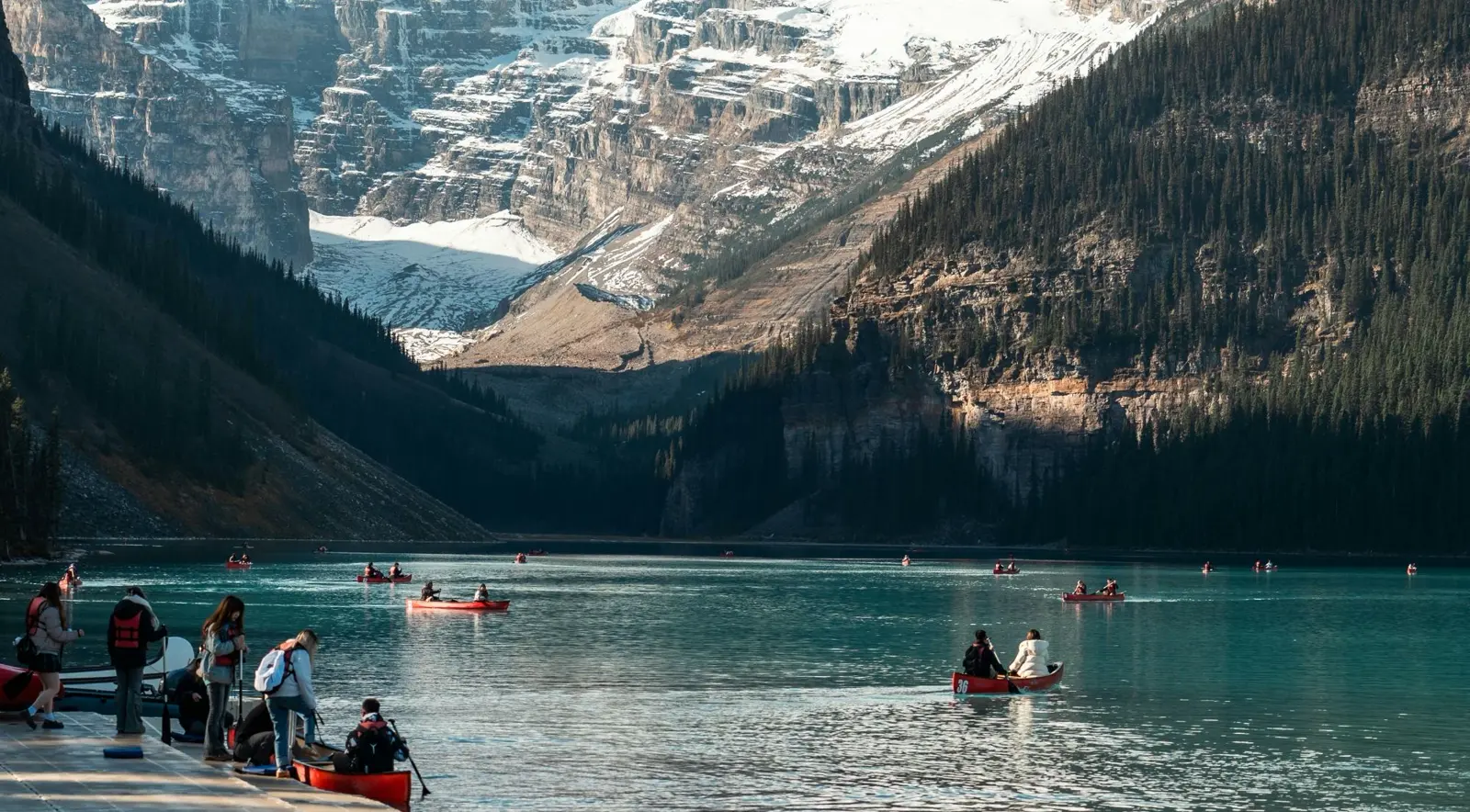
The turquoise lake below the Victoria Glacier with the Fairmont Chateau on its shore. Free lakeshore walk (~2 km flat), iconic red canoe rentals (CAD $180/hr, first-come, first-served, no reservations), and hiking to the Lake Agnes Tea House or Plain of Six Glaciers. Lakeshore parking is $42/day and fills before sunrise in summer — use the Parks Canada Park & Ride shuttle or Roam Route 8X. Both lakes are connected by the free Lake Connector shuttle (15 minutes).
Emerald Lake & Yoho National Park
Just west over the Continental Divide (~27 km from Lake Louise), Emerald Lake's vivid green water sits in one of the Rockies' most peaceful settings — canoe rentals (~CAD $100/hr), a 5 km shoreline loop, and the Emerald Lake Lodge dining room. Add the Natural Bridge (a rock arch carved by the Kicking Horse River, 5-minute walk) and Takakkaw Falls (373 m, Canada's second-highest waterfall; road open mid/late June–mid-October). Your Banff park pass is valid in Yoho — see the Yoho National Park guide for the rest of the park, and the Banff park pass guide for 2026 rates.
The Town of Banff Cluster
Banff Gondola (Sulphur Mountain)
An 8-minute ride to a 2,281 m summit with views over six mountain ranges, a boardwalk to Sanson's Peak, the "Above Banff" theatre, and the Sky Bistro restaurant. Open year-round (except a short November closure). Tickets are dynamically priced — adult round-trips run roughly CAD $55–96+ depending on date, youth (6–15) ~$30–46, children 5 and under free. Free same-day Roam Route 1 shuttle from downtown with your ticket (May 15–Oct 12). Book online in advance — on-the-day prices are highest and the gondola sells out on peak days. Summer Sunset Festival (live music) runs June 19–September 7, 2026.
Banff Upper Hot Springs
Canada's historic open-air mineral pool at the base of Sulphur Mountain, drawing soakers since 1886 and kept at ~37–40°C, with Rundle and Cascade mountain views. The 1932 bathhouse is a federal heritage building with interpretive exhibits. Reopened late March 2026 after a multi-month renovation. 2026 admission: adult CAD $19.75, senior/youth $17.25, child under 3 free, family $64.25 (locker token included). First-come, first-served — no online booking. Hours typically 1–10 p.m. daily (last entry 9:30 p.m.). Reach it on Roam Route 1; $17.50/day parking. Atmospheric in winter evenings.
Cave and Basin National Historic Site
The thermal springs discovered in 1883 by three Canadian Pacific Railway workers — Frank McCabe and brothers Tom and William McCardell — sparked Canada's national park system; the ensuing land protection made Banff Canada's first national park in 1885. Walk into the original cave, follow boardwalks home to the endangered Banff Springs snail, and explore interactive exhibits. 2026 adult admission: CAD $9.00, senior $7.50, youth free. Free during the Canada Strong Pass window (June 19–September 7). Hours: daily 9:30 a.m.–5 p.m. (May 15–Oct 15); Thu–Mon 11 a.m.–5 p.m. (off-season). A free 30-minute "Cave and Basics" tour is included.
Bow Falls & Surprise Corner
A wide, powerful waterfall on the Bow River just below the Fairmont Banff Springs Hotel, a short walk or drive from downtown. Surprise Corner is the classic viewpoint for the castle-in-the-Rockies shot of the hotel above the falls. Free. Combine with a stroll on Banff Avenue and the Cascade of Time Garden — a free ~4-acre terraced heritage garden at the south end of Banff Avenue, peak bloom late June–early September. The Banff Park Museum, Canada's oldest natural history museum, anchors the south end of Banff Avenue, and no stroll down the avenue is complete without a classic BeaverTails fried pastry.
Whyte Museum of the Canadian Rockies
Located at 111 Bear Street and founded by artists Peter and Catharine Whyte, this is Banff's dedicated mountain-culture museum — art galleries, archives and rotating exhibitions tracing the human history of the Canadian Rockies. Open daily 10 a.m.–5 p.m. 2026 admission: adult CAD $15, senior/student $12.50, locals $10, youth under 17 free (members and Indigenous visitors free). A worthwhile rainy-day stop and an easy walk from Banff Avenue.
Banff Gondola Admission Ticket
The highest-reviewed single attraction in Banff — 4,500+ reviews, 4.7 rating. The 8-minute gondola ride rises to 2,281 m above the town, with a summit boardwalk, the Sanson's Peak Cosmic Ray Station, interpretive centre and dining. Dynamic pricing means booking in advance is both cheaper and smarter — the Gondola sells out on peak summer days.
Johnston Canyon, Lake Minnewanka & Wildlife
Johnston Canyon
Banff's most popular walk — Parks Canada recorded 714,773 visitors here in 2025. Suspended catwalks bolted to limestone canyon walls lead to the Lower Falls (1.1–1.2 km, tunnel viewpoint) and Upper Falls (~2.7 km). Strong hikers continue to the Ink Pots — vivid blue-green mineral springs in an alpine meadow (~5.7 km one-way, 330 m gain, 3+ hours). Free; parking fills by ~9 a.m. — arrive early or take Roam Route 9 (2026 bus fares: $5 adult, $2.50 senior/youth, free under 12). In winter the frozen falls make it a famous ice walk (wear microspikes or book a guided tour). Stay on the marked catwalks — off-trail access is prohibited to protect nesting black swifts. Johnston Canyon sits on the Bow Valley Parkway, which has seasonal closures each spring and fall — see the closure callout below for exact 2026 dates.
Lake Minnewanka Cruise
A ~1-hour narrated Classic Cruise on Banff's largest lake to Devil's Gap, aboard heated glass-enclosed boats. Also Premium (~1.5 hr), adults-only Beer Voyage, and Junior Explorer family cruises, plus boat rentals and guided fishing. 2026 season: May 8–October 12. Classic Cruise departs on the hour, 10 a.m.–6 p.m. Dynamic pricing; adult from about CAD $75, child from ~$49. Alberta residents save up to 20%. Free same-day shuttle from Banff June 13–September 7, or Roam Route 6 (May 13–October 4).
Wildlife Viewing & Evening Safaris
Banff is prime habitat for elk, bighorn sheep, deer, black and grizzly bears. Guided Evening Wildlife Safari bus tours run ~April–October (~2 hours, about $72 adult / $46 child); operators report wildlife on ~95% of tours. Dawn and dusk are peak activity windows. Always keep a safe distance, never feed wildlife, and carry bear spray on trails. Roadside wildlife viewing along the Bow Valley Parkway (Hwy 1A) is excellent and free.
Bow Valley Parkway 2026 closures — plan your Johnston Canyon and wildlife-drive visit around these exact windows:
- Overnight closure, March 1–June 25, 2026: the eastern 17 km section (Fireside Picnic Area to Johnston Canyon Campground) is closed to all travel — vehicles, cyclists and walkers — 8 p.m.–8 a.m., to protect critical habitat for wolves, cougars and bears.
- Daytime cycling closure, roughly May 1–June 25 and September 1–October 6, 2026: that same eastern stretch closes to private vehicles 8 a.m.–8 p.m. for a vehicle-free cycling and walking experience — a program Parks Canada has extended through 2030.
During either closure, reach Johnston Canyon and points west via the Castle Junction exit off the Trans-Canada Highway. The western section, from Johnston Canyon to Lake Louise, stays open to vehicles throughout.
Banff: Lake Minnewanka Cruise
A narrated cruise on Banff's largest lake — one of the easiest and most rewarding half-day activities in the park. No car needed: a free shuttle from downtown Banff connects with the cruise June 13–September 7. Boat rentals and guided fishing are also available at the dock.
Banff: Evening Wildlife Safari Guided Tour
A guided dusk tour by bus through the valleys around Banff looking for elk, bighorn sheep, deer and black bears. Elk and bighorn sheep sightings are near-certain; bears are seasonal. A great add-on for an afternoon or evening after the lakes, with no hiking required.
Alpine Day Trips & Town Hikes
Sunshine Meadows / Sunshine Village
In summer the Banff Sunshine gondola (base 1,660 m to village 2,159 m) plus the Standish sightseeing chairlift (to ~2,385 m) access world-class alpine wildflower meadows and lakes — Rock Isle, Grizzly and Larix lakes. 2026 summer sightseeing opens July 6; gondola + chairlift tickets around CAD $75 adult; free shuttle from Banff. One of the best half-day hikes in the park for wildflower season. In winter it's a SkiBig3 resort with the longest season (into late May) — it opened November 2, 2025 for the 2025–26 season, the earliest opening in the resort's 98-year history, and a brief summer ski season June 20–July 5, 2026.
Mount Norquay
Seven minutes from downtown Banff. The North American sightseeing chairlift (opens June 10, 2026) rises to ~7,000 ft with sweeping Bow Valley views and the Cliffhouse Bistro; adult ~CAD $85, senior/youth ~$72, child (6–12) ~$42. Mount Norquay is also home to Banff's only Via Ferrata — guided cable-and-ladder climbing routes with four options from the Explorer (~$190) to the Summiteer (~$385), running roughly June–October. A winter ski hill with night skiing and a beginner area expanded for 2025-26 — Norquay is celebrating its 100th anniversary in 2026 and added a tubing park for winter visitors.
Tunnel Mountain & Cascade Mountain
Tunnel Mountain is the classic quick summit hike from the townsite — ~4.3 km round trip, ~300 m gain, 1.5–2 hours — with panoramic Bow Valley views and no car required. Ideal for acclimatizing or a short day. Cascade Mountain (2,998 m), the dramatic peak looming over Banff Avenue, is a serious full-day scramble for experienced hikers only but anchors many of the town's best photos. Vermilion Lakes — three shallow lakes just minutes from town — are the ideal spot for wildlife, sunrise reflections of Mount Rundle and after-dinner stargazing.
Canoeing, Golf & Horseback Riding
Canoeing the Bow River (Banff Canoe Club)
For a low-key paddle right in town, the Banff Canoe Club rents canoes, kayaks and stand-up paddleboards from docks at the corner of Wolf Street and Bow Avenue, five minutes' walk from Banff Avenue. From here you can drift a gentle stretch of the Bow River or follow Forty Mile Creek toward the Vermilion Lakes, watching for eagles, elk and muskrats. The season runs mid-May to October; rentals are first-come, first-served — no reservations. For more ambitious open-water paddling, head to Lake Minnewanka or, over in Yoho, Emerald Lake.
Golf at Fairmont Banff Springs
The Fairmont Banff Springs Golf Course is one of the most scenic rounds on Earth — the original 18 holes were designed by Canadian master architect Stanley Thompson in 1928, joined by a Cornish-and-Robinson 9 (the Tunnel Mountain course) added in 1989 for 27 holes total. Fairways wind along the Bow River beneath Mount Rundle and Sulphur Mountain, and the par-3 4th, "Devil's Cauldron," is world-famous. For 2026 the course opens in phases — Tunnel 9 and the back 9 on May 8, all 27 holes by May 15.
Horseback Riding
Banff Trail Riders (Warner Stables) runs guided trail rides from the Spray River Corrals near the Fairmont and from Warner Stables, ranging from one-hour outings to full-day cookout rides, plus winter sleigh rides. At Lake Louise, Brewster Stables offers rides toward the Plain of Six Glaciers and Lake Agnes. Minimum ages (typically 8) and weight limits apply, and advance reservations are required.
Icefields Parkway & Columbia Icefield — A Full Dedicated Day
~230 km from Lake Louise to Jasper (3 hours without stops) — give it a full day. Key stops: Bow Lake, Peyto Lake at Bow Summit, Mistaya Canyon, then the Columbia Icefield.
The Icefields Parkway (Highway 93 North) is the drive most visitors call the best day of their trip. Running north from Lake Louise to Jasper through an unbroken corridor of peaks, glaciers and wildlife habitat, the road passes Bow Lake (wide glacial lake with Crowfoot Glacier views), Peyto Lake at Bow Summit (the wolf-head-shaped turquoise lake on the highest point of the parkway, 2,067–2,088 m — go early, before tour buses arrive), Mistaya Canyon, and the Athabasca River valley. There is no cell service and no fuel for long stretches — fill up in Lake Louise or Canmore before starting.
The headline stop is the Columbia Icefield Adventure (~2.5 hours north of Banff), which combines a ride onto the Athabasca Glacier in a massive Ice Explorer vehicle with the glass-floored Skywalk cantilevered 280 m above the Sunwapta Valley. Season: May 1–October 12, 2026. Tickets are dynamically priced; adult admission historically around CAD $115–125. Book in advance — both because it sells out and because dynamic pricing means earlier is cheaper.
Columbia Icefield Skywalk & Ice Explorer Ticket
The Ice Explorer takes you onto the surface of the Athabasca Glacier — a massive vehicle purpose-built for crevasse-cut glacier terrain. The Skywalk follows: a glass-floored lookout cantilevered over a 280 m drop above the Sunwapta Valley. Together they make for the most dramatic 2.5–3 hours on the Icefields Parkway. Book ahead — this is the Parkway's most popular stop by a wide margin.
Winter in Banff: Skiing, Skating & the Snow Season
Banff isn't just a summer park — the season runs roughly early November to late May, with the Big 3 ski resorts, a lakeside skating rink and a full winter events calendar keeping it busy right through.
One SkiBig3 lift ticket covers all three resorts, which together offer 7,948 acres of skiable terrain, two gondolas and famously dry Canadian Rockies powder (about 30 feet a year). Banff Sunshine Village opened for the 2025–26 season on November 2, 2025 — the first Canadian resort to open that year — with the resort's VP of Communications, Kendra Scurfield, calling it likely "the earliest opening in the resort's 98-year history." Lake Louise Ski Resort, one of North America's largest, is rolling out its new Richardson's Ridge expansion in phases, and Mt. Norquay — the small, local hill minutes from town — is celebrating its 100th anniversary with night skiing and a tubing park.
Ice Skating
Skating on Lake Louise in front of the Fairmont Chateau — complete with an ice bar, fire pits, sleigh rides and an elaborate ice castle — is regularly ranked among the world's most beautiful rinks; the maintained lake rink typically runs mid-December into spring. In town, skate at the Fenlands Banff Recreation Centre rinks or the outdoor rink at the Banff Recreation Grounds.
Snowshoeing, Cross-Country Skiing & Sleigh Rides
Guided ice walks (including through frozen Johnston Canyon), snowshoeing and cross-country skiing round out the shoulder months, and Warner Stables runs horse-drawn sleigh rides through the snowy Bow Valley. Banff's winter season traditionally kicks off with the January SnowDays festival — snow-sculpture competitions, fireworks and events around town.
The Big 3 Ski Resorts
Banff Sunshine Village (high-alpine, snow-sure, longest season into late May), Lake Louise Ski Resort (vast cruising terrain, new Richardson's Ridge expansion) and Mt. Norquay (small, local, close to town, celebrating its 100th anniversary with night skiing and tubing) make up the Big 3 — see the Sunshine Meadows and Mount Norquay cards above for what the same lifts offer in summer.
Banff Itineraries: 1 Day, 3 Days and 5 Days
Each day is built around a geographic cluster — so you're not driving back and forth across the park.
-
Highlights Blitz — Lakes + Gondola
Start early. Morning at Lake Louise (lakeshore walk or short hike to Lake Agnes Tea House) via the Parks Canada shuttle from the Park & Ride. Midday: Moraine Lake via the free Lake Connector — an hour is enough for the Rockpile and lakeshore. Afternoon: back to Banff for the Banff Gondola up Sulphur Mountain. Evening: walk Banff Avenue, dinner, and optionally Bow Falls and Surprise Corner. If time is short, choose either the two lakes or the gondola and town — doing all three in one day is a long push.
-
The Classic Banff Visit
Day 1 — Lake Louise + Moraine Lake: Dedicate the full day to the two lakes (shuttle-based from the Park & Ride). Add a hike above Lake Louise (Agnes Tea House or Plain of Six Glaciers) and an hour of canoeing at Lake Louise. A guided lakes tour handles all access logistics in one booking. Day 2 — Town of Banff cluster: Banff Gondola in the morning, Cave and Basin or the Whyte Museum, Bow Falls and Surprise Corner, Banff Avenue, then an evening soak at the Upper Hot Springs. All reachable on Roam Route 1. Day 3 — Johnston Canyon + Lake Minnewanka: Johnston Canyon early (catwalks, Lower and Upper Falls, optionally the Ink Pots), Bow Valley Parkway wildlife spotting on the drive back, then the Lake Minnewanka Cruise in the afternoon. Finish with an evening wildlife safari.
-
Comprehensive — Including Icefields & Yoho
Days 1–3: As the 3-day itinerary above. Day 4 — Icefields Parkway (full day): Drive Highway 93 North with stops at Bow Lake, Peyto Lake at Bow Summit (one of the Rockies' most striking viewpoints — go early), and Mistaya Canyon, then the Columbia Icefield Adventure (Ice Explorer + Skywalk, ~2.5 hrs). Return to Banff or overnight near Lake Louise. Start early — this is a long day even without detours. Day 5 — Yoho National Park or alpine day: Either Emerald Lake, Natural Bridge and Takakkaw Falls in Yoho (full, leisurely day over the border into BC), OR a summer alpine day at Sunshine Meadows (gondola + Standish chairlift + wildflower meadow hiking, opens July 6, 2026) or Mount Norquay (chairlift + Via Ferrata, ~7 minutes from town).
Geographic tip: group your days around location clusters — (1) Lake Louise + Moraine Lake together; (2) Banff town + Gondola + Hot Springs; (3) Johnston Canyon + Bow Valley Parkway; (4) Lake Minnewanka northeast loop; (5) Icefields Parkway as a standalone day; (6) Yoho as a standalone day. This avoids backtracking and lines up with Roam Transit routes.
Banff Practical Tips 2026: Pass, Parking, Transit & Seasons
Park pass
Everyone entering the park needs a Parks Canada pass. Free June 19–September 7, 2026 (Canada Strong Pass — no registration needed). Outside that window: adult $12.25/day, senior $10.75, youth free, family/group $24.50. Annual Discovery Pass $83.50 adult pays for itself after ~7 visits. A CPI-based fee increase took effect January 1, 2026, so expect day-pass prices to tick up slightly each year.
Parking — the honest picture
All major lots fill by 10 a.m. on summer days. Best free option: Banff Train Station (~500 stalls, 9-hr limit, 8-min walk to Banff Avenue). From there, Roam Transit reaches the Gondola, Minnewanka, Johnston Canyon and Lake Louise. Don't count on finding a spot at any attraction lot after 9 a.m.
Roam Transit
Public buses linking Banff, Canmore and Lake Louise. Route 1 → Gondola & Hot Springs. Route 3 → Canmore–Banff connection (runs year-round, great for car-free travellers staying in Canmore). Route 6 → Lake Minnewanka. Route 9 → Johnston Canyon. Route 8X → Lake Louise ($12.50 adult, reservations recommended June–Oct). A $30 Roam Reservable Super Pass covers all routes plus the Lake Connector to Moraine Lake.
Best season for first-timers
Mid-July to mid-September for turquoise lakes, all roads and gondolas open, warmest weather. Late September for golden larches and the elk rut — spectacular but busy. December–March for skiing, ice walks and the Johnston Canyon winter experience. June has fewer crowds but high lakes may be frozen.
Getting there from Calgary
Banff is ~128 km (~1.5 hrs) west of Calgary via the Trans-Canada Highway. Shuttle options include Banff Airporter ($88.90 adult one-way, door-to-hotel) and Brewster Express (~$78–90 one-way). On-It's cheap weekend bus is NOT operating in 2026. For transport details, see our Calgary to Banff guide.
What to bring
Layers for changeable mountain weather, sturdy walking shoes (some canyon trails are wet and rocky), sunscreen and a hat. Bear spray for any off-trail hiking. Download offline maps before arriving — cell service is patchy at many major stops. Screenshot shuttle reservations before leaving cell range.
Things to Do in Banff 2026: Frequently Asked Questions
Must-dos, days needed, free entry, hot-springs status, lake access, Bow Valley Parkway closures, winter activities and more — answered.
What are the top must-do things in Banff National Park?
The consensus must-dos are the Banff Gondola up Sulphur Mountain, Lake Louise and Moraine Lake, the Banff Upper Hot Springs, Johnston Canyon and a Lake Minnewanka cruise — plus simply walking Banff Avenue and Bow Falls. If you have extra time, add canoeing the Bow River, a round at the Fairmont Banff Springs Golf Course, or, in winter, skating on Lake Louise.
How many days do you need in Banff National Park?
One well-timed day covers the headline lakes (Louise and Moraine) plus the Banff Gondola or Johnston Canyon. Three days is the classic visit: the two lakes on day one, the Banff town cluster (gondola, hot springs, Cave and Basin) on day two, and Johnston Canyon plus Lake Minnewanka on day three. Five days lets you add the Icefields Parkway with the Columbia Icefield Adventure and a full day in Yoho National Park.
Is park entry free in Banff in 2026?
Yes — under the Canada Strong Pass, admission to Banff National Park is free for everyone from June 19 to September 7, 2026 inclusive. No pass needs to be purchased. Outside that window, a daily adult pass is CAD $12.25 (a CPI-based fee increase took effect January 1, 2026). Note that parking, shuttles, tours and the Upper Hot Springs are not included in the free park entry.
Is the Banff Upper Hot Springs open in 2026?
Yes. The Upper Hot Springs reopened in spring 2026 after closing in September 2025 for a seven-month renovation that added an accessibility ramp, new tile work and a rainfall drain. Soaking here dates back to 1886, and the 1932 bathhouse is a federal heritage building. 2026 admission is $19.75 adult; entry is first-come, first-served with no reservations. Confirm current hours with Parks Canada before visiting, as recent reports differ on whether it opens at 10 a.m. or 1 p.m.
How do I get to Moraine Lake and Lake Louise?
Moraine Lake Road is closed to private vehicles — you must use a Parks Canada shuttle, a commercial shuttle or bus, or a guided tour (season roughly June 1–October 12, 2026). Lake Louise has paid lakeshore parking ($42/vehicle) that fills before sunrise in summer, so most visitors use the Park & Ride shuttle or Roam Route 8X instead. See our Lake Louise shuttle guide and Parks Canada reservation guide for exact booking windows.
Can I visit Johnston Canyon during the Bow Valley Parkway closures?
Yes. During the seasonal overnight closure (March 1–June 25, 2026) and daytime cycling closure (roughly May 1–June 25 and September 1–October 6, 2026) on the eastern Bow Valley Parkway, reach Johnston Canyon by cycling in, taking a seasonal shuttle, or driving via the Castle Junction exit from the west. The western section of the parkway, from Johnston Canyon to Lake Louise, stays open to vehicles throughout.
What is there to do in Banff in winter?
Ski or ride the Big 3 (Sunshine Village, Lake Louise Ski Resort and Mt. Norquay) on a single SkiBig3 ticket, skate on Lake Louise or at the Fenlands Recreation Centre, snowshoe or cross-country ski, take a guided ice walk through frozen Johnston Canyon, go on a Warner Stables sleigh ride, or soak in the Upper Hot Springs. The season runs roughly early November to late May and traditionally kicks off with the January SnowDays festival.
Is Banff good for non-hikers and families?
Absolutely. The Banff Gondola, Upper Hot Springs, Lake Minnewanka cruise, Bow Falls, Vermilion Lakes, Cave and Basin, canoeing the Bow River and a stroll down Banff Avenue are all low-effort and family-friendly, and most don't require any hiking at all.
How much does the Banff Gondola cost in 2026?
The Banff Gondola uses dynamic pricing — there is no single fixed rate. Adult round-trip tickets typically range from about CAD $55 to $96+ depending on the date and how far in advance you book; youth (6–15) roughly $30–46; children 5 and under are free but still need a ticket. Booking online in advance is cheaper than buying on the day. A free same-day Roam Route 1 shuttle from downtown Banff is included with your ticket (May 15–October 12, 2026). See our Banff Gondola guide for summit tips, parking and the hike-up option.
Can you visit Banff without a car?
Yes — and 2026's congestion makes it the smarter choice. Roam Transit connects Banff, Canmore and Lake Louise with buses to the Gondola, Lake Minnewanka, Johnston Canyon and Lake Louise. A CAD $30 Roam Reservable Super Pass gives unlimited Roam travel plus the Parks Canada Lake Connector to Moraine Lake. Guided tours cover the most popular lakes with hotel pickup from Banff, Canmore or Calgary.
When is the best time to visit Banff?
For a first visit with everything open: mid-July to mid-September. For fewer crowds with dramatic scenery: the last two weeks of September (golden larches and the elk rut). For skiing and the Johnston Canyon ice walk: December through March. June has the lowest crowds for a summer visit but high lakes may still be frozen and some roads (Moraine Lake Road opens June 1) are just opening.
What is the single best thing to do in Banff?
Most first-time visitors rank Moraine Lake — the deep-turquoise lake below the Valley of the Ten Peaks — as the single most spectacular stop. Pair it with Lake Louise (connected by the free Parks Canada Lake Connector shuttle, 15 minutes) and you have the best of Banff in a single day. Private cars cannot reach Moraine Lake (road closed year-round since 2023), so you need a shuttle or guided tour. See our complete Moraine Lake guide for access options.