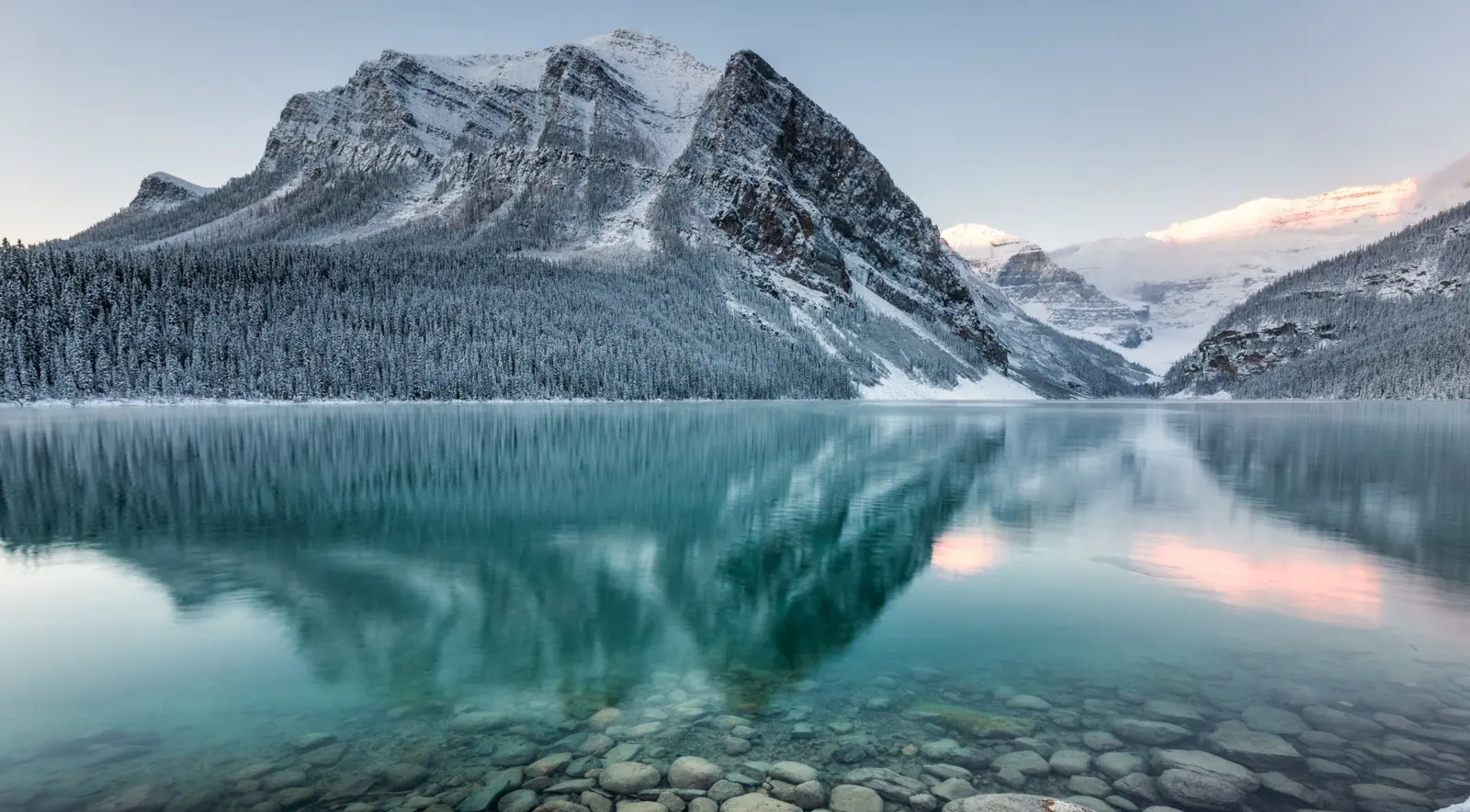
- 21 kmBanff's largest lake
- 1 hrClassic Cruise
- Route 6car-free from Banff
- Free lotas of 2026
- Jul 10-Sep 15trail restriction past Stewart Canyon
Why Lake Minnewanka Is the Low-Stress Banff Lake Day
Lake Minnewanka is the major Banff lake that still feels straightforward. Moraine Lake requires shuttle access and Lake Louise parking or shuttle planning; Minnewanka is about 15 minutes from downtown Banff, reachable by Roam Transit, and does not need a Parks Canada shuttle reservation.
The lake is not just a viewpoint. The cruise reaches toward Devil's Gap, the Lakeshore Trail leads to Stewart Canyon and beyond, and the water hides the submerged resort village of Minnewanka Landing. It also pairs naturally with the Banff Gondola, Bow Falls, Two Jack Lake and Johnson Lake for a full Banff town-and-lakes day.
Banff: Lake Minnewanka Cruise
The Classic Cruise sails east from the marina toward Devil's Gap on a heated, glass-enclosed boat. Guides explain the lake's geology, wildlife, Stoney Nakoda history and the submerged Minnewanka Landing townsite. Watch the shoreline for bighorn sheep, deer, bald eagles and occasional bears.
Devil's Gap sits above the lake's deepest point — 152 metres down — and reaching it on foot would mean, in Pursuit's words, "you'd have to travel 30 kilometres deep into the Canadian Rockies backcountry." The boat gets you there in about half an hour, where the captain typically pauses the engine for a moment of quiet before turning back. The Classic Cruise runs the full 2026 season, May 8 – October 12, departing on the hour from mid-morning with extra half-hourly sailings at peak summer.
- One-hour guided cruise on Banff's largest lake
- Live commentary and captain-led interpretation
- Views toward Devil's Gap, 152 m deep, and the Ghost Lakes area
- Same-day cruise ticket usually includes free Roam Route 6 fare
- 2026 season: May 8 – October 12
Premium, Junior Explorer & Beer Voyage Cruises
Pursuit runs four cruise formats for 2026, from a family-friendly treasure hunt to an 18+ evening beer sampling on the water.
Premium Cruise
Aboard a refreshed vessel with upgraded seating and VIP check-in, the Premium Cruise adds pine tea and chocolate-covered Saskatoon berries plus a longer stop at Devil's Gap. Runs May 22 – September 27, 2026.
Junior Explorer Cruise
A family cruise built around a treasure hunt, games and a keepsake journal for kids to fill in along the way. One child rides free per paying adult.
Beer Voyage
A 90-minute, 18-and-over evening cruise sampling Alberta craft beers, timed to catch soft evening light on the lake. Hosted Friday sailings spotlight a different Alberta brewery each week. Runs May 22 – September 27, 2026.
Other Experiences You Might Enjoy
After Lake Minnewanka, compare Banff lake cruises, the Lake Minnewanka Scenic Drive, Two Jack Lake, Johnson Lake, Banff Gondola tickets, Bow Falls sightseeing, Lake Louise tours and Moraine Lake shuttle alternatives.
How to Get to Lake Minnewanka
Drive the scenic loop
From Banff, follow Banff Avenue north and continue onto Lake Minnewanka Scenic Drive. The 24 km paved loop includes Cascade Ponds, Johnson Lake, Two Jack Lake, Lake Minnewanka and the Bankhead ghost-town area.
Use Roam Route 6
Route 6 runs from downtown Banff to Cascade Ponds, Johnson Lake, Two Jack Lake and Lake Minnewanka in about 25 minutes, for a standard fare of a few dollars with kids riding free. A same-day cruise ticket usually covers your Route 6 fare for free, and Pursuit also runs a dedicated free shuttle to the marina in peak summer.
Parking and park pass
The Lake Minnewanka day-use lot, including a separate lot for vehicles towing boat trailers, remains free and first-come, first-served for 2026 — a contrast to Parks Canada's new $17.50/day pilot fee at the Sulphur Mountain (Banff Gondola) lots and the $42/day Lake Louise Lakeshore lot. It still fills on July and August weekends, roughly 10 am-3-4 pm, so arrive early or take Route 6. You'll also need a valid Banff National Park pass just to be in the park — see our Banff park pass guide.
Minnewanka Lakeshore Trail and Stewart Canyon
The Minnewanka Lakeshore Trail starts at the day-use area and follows the north shore. The first section is easy, wide and flexible: walk a short lakeside stretch, continue about 2 km each way to the Stewart Canyon bridge, or keep going toward the Aylmer Lookout junction for a quieter backcountry feel.
From July 10 to September 15, Parks Canada normally requires hikers past the Stewart Canyon bridge to travel in a tight group of four or more, carry bear spray, and leave dogs and bikes behind. This shoreline is prime grizzly habitat, and temporary closures can happen, so check trailhead signs before continuing.
Fishing, Diving, Paddling and the Sunken Town
Lake trout water
Lake Minnewanka holds Banff's premier lake-trout fishery — Pursuit calls it "one of the top 10 spots in North America to catch this game fish," with fish that can exceed 20 pounds in the cold, deep water fed by roughly 50 natural springs. It's also the only Banff water where you can keep fish: Parks Canada's daily possession limit for lake trout here is exactly 2 fish per licensed angler, while nearly everywhere else in the park is catch-and-release. You need a national park fishing permit (not an Alberta provincial licence), available at the Banff Visitor Centre, and Pursuit runs guided fishing charters with all gear included.
Minnewanka Landing
The 1941 dam raised the lake about 30 m and submerged the old resort village of Minnewanka Landing. All dives here are cold-water, high-altitude dives — the lake sits at about 1,450 m — with a maximum depth of roughly 100 m; Parks Canada catalogues 16 features across three main dive areas, including foundations, sidewalks, bridge remains and old dam structures. Visibility is best before spring runoff and after fall. There are no dive shops or gear rentals inside the park, so divers need their own equipment and cold-water experience.
Banff's motorboat exception
Minnewanka is the only Banff lake that permits private motorboats. Canoes, kayaks and motorboats are also rented at the boathouse, with invasive-species self-certification or inspection rules applying before launch.
Black Anchor Snack Shop
The day-use area has washrooms and picnic spots, and the Black Anchor Snack Shop at the dock sells burgers, ice cream and lunch fare. Options on the water itself are limited, so pack food and water if you're spending the day.
Two Jack Lake, Johnson Lake and the Minnewanka Loop
Two Jack Lake
Two Jack Lake is smaller, calmer and famous for Mount Rundle reflections. It is a natural sunrise, picnic, paddling or campground stop before or after Minnewanka.
Johnson Lake
Johnson Lake has an easy roughly 3 km loop trail and is popular for casual swimming and picnics in summer. It is also on Roam Route 6.
Winter closure
The western section of the Minnewanka Loop normally closes to vehicles from roughly November to May as a wildlife corridor, while access to the lake from the eastern side remains available.
The Sunken Town of Minnewanka Landing
Lake Minnewanka's most fascinating feature is invisible from the surface. The lake you see today is far larger than the original natural lake — it has been dammed three times to raise the water level and generate hydroelectric power, drowning an entire resort village in the process. The Stoney Nakoda people called the lake "Minn-waki," or Lake of the Spirits, long before any of that history began.
People have hunted and camped along these shores for thousands of years; archaeologists have dated stone tools and a Clovis point spearhead here to as early as 10,000 years ago, and Pursuit notes artifacts at Sandy Beach reaching back as far as 14,000 years. In 1886 a log hotel called the "Beach House" opened on the original shoreline, and the lake's first tour boat, the steam-powered Lady Brooke, set out in 1889. By 1912 a summer resort village named Minnewanka Landing had grown up — four avenues and three streets, with hotels, wharves, restaurants and sightseeing sailboats that by the early 1900s included the Lady of the Lake and the Daughter of the Peaks.
The first dam was built in 1895 to improve the boggy shoreline for boating. A second dam in 1912, built by Calgary Power Co. to store water for a downstream hydroelectric plant on the Cascade River, flooded part of the townsite — but the village kept growing, adding 42 cabin lots over the next two decades. Its end came in 1941, when — under the War Measures Act, which temporarily suspended the 1930 National Parks Act's ban on industrial development — Calgary Power built the third and current embankment dam, raising the lake about 30 metres and submerging the townsite, the 1912 dam and the bridge over Devils Creek completely.
Today Minnewanka Landing is one of the best-preserved submerged historic villages in Canada, visited only by scuba divers who can still swim past foundations, sidewalks and fireplaces on the lake bottom. It's the story the cruise captains bring to life, and it's why Minnewanka feels like more than just another pretty lake.
Best Time to Visit Lake Minnewanka
Time of day
Go early morning or late afternoon/evening for calmer water, better light, easier parking and fewer crowds. Evening Beer Voyage cruises catch soft light on the lake.
Quieter than the marquee lakes
Minnewanka is consistently less crowded than Lake Louise and Moraine Lake, with far easier access — no reserved shuttle required and, for now, free parking. If the Lake Louise and Moraine Lake shuttle logistics feel daunting, Minnewanka is the relaxed alternative.
Shoulder season
Late spring and September/October bring thinner crowds and fall colour along the Scenic Drive, though the cruise season winds down by mid-October and the loop's western section closes for winter.
Tips for Visiting Lake Minnewanka
- Buy your park pass in advance and book cruise tickets online — peak-summer sailings sell out.
- Arrive early (or take Roam Route 6) to beat the midday parking crunch.
- Bring layers — it's cool and breezy on the water even on warm days.
- Carry bear spray if you're hiking the Lakeshore Trail, and respect the July 10-September 15 group-of-four rule past Stewart Canyon.
- Pack food and water; on-site dining is limited to the Black Anchor Snack Shop.
- Never approach or feed wildlife — stay 30 m from bighorn sheep and elk, 100 m from bears.
- Self-certify any watercraft or fishing gear for invasive species before entering the water.
Lake Minnewanka FAQ
Who operates the Lake Minnewanka cruise?
The cruise is operated by Pursuit (Banff Jasper Collection), the same company that runs the Banff Gondola. It's the only guided lake cruise in Banff National Park.
How long is the Lake Minnewanka cruise and where does it go?
The Classic Cruise lasts about one hour and sails east to Devil's Gap, a glacial gap at the far end of the lake, before returning to the dock. The Premium Cruise runs about 1.5 hours with a longer stop at Devil's Gap.
How much does the Lake Minnewanka cruise cost?
Pricing is tiered by cruise type (Classic, Premium, Junior Explorer, Beer Voyage), with kids 5 and under free and Alberta residents saving up to 20% on some cruises. Combo tickets with the Banff Gondola and the Pursuit Pass can reduce per-attraction cost. Confirm current rates with Pursuit before booking, as prices change seasonally and tickets are non-refundable.
Is parking free at Lake Minnewanka?
As of the 2026 season, the Lake Minnewanka day-use parking lot is free and first-come, first-served — unlike Sulphur Mountain ($17.50/day) and Lake Louise Lakeshore ($42/day), which now charge. The lot fills midday in summer, so arrive early or take Roam Route 6.
How do I get to Lake Minnewanka without a car?
Take Roam Public Transit Route 6 from downtown Banff (about 25 minutes). If you hold a same-day Lake Minnewanka Cruise ticket, you ride Route 6 free.
Can you swim, fish, or dive at Lake Minnewanka?
The water is glacial and very cold for swimming. Fishing is excellent — it's the park's top lake-trout fishery and the only Banff lake with a keep limit (2 lake trout, Parks Canada permit required). It's also a renowned cold-water scuba site because of the submerged town of Minnewanka Landing.
What's the story of the sunken town?
Minnewanka Landing was a resort village submerged when the lake was dammed and raised for hydroelectric power — partly in 1912 and completely in 1941. Its foundations, sidewalks and old dam remain preserved on the lake bottom and are now visited only by divers.
Is Lake Minnewanka a good alternative to Lake Louise and Moraine Lake?
Yes. It's easier to reach (15 minutes from Banff), less crowded, and doesn't require a reserved shuttle, making it one of the most accessible major lakes in the park — though its scenery is more about scale and wilderness than the intense turquoise of Louise or Moraine.